



Business coaching is a structured development relationship that helps a person examine a work challenge, choose an action and learn from the result. It can support a business owner or manager who wants to improve a specific behavior. This article explains when coaching fits, how to select a coach and how to judge progress without promising guaranteed business results.
What business coaching actually involves
A coach uses questions, listening, reflection and feedback to help the client examine their thinking and actions. The client remains responsible for decisions and implementation. The International Coaching Federation describes coaching as a collaborative process that encourages clients to develop their potential. The practical value depends on a clear goal and work between sessions.
For example, a manager may know how to delegate but repeatedly take work back from the team. Coaching can explore the assumptions behind that behavior and help the manager test a different approach. It does not replace a missing delegation policy, adequate staffing or the authority needed to make decisions.
Choose coaching, mentoring, training or consulting
| Need | Useful approach | Typical output |
|---|---|---|
| Practice an unfamiliar skill | Training | Instruction and assessed practice |
| Learn from someone with relevant experience | Mentoring | Experience-based guidance |
| Examine habits and improve personal action | Coaching | A chosen action and reflection on results |
| Diagnose a business problem and develop recommendations | Consulting | Analysis, options and agreed deliverables |
These approaches can complement one another. Ask the provider to explain which role they are performing at each stage. If a coach starts recommending a new operating model, clarify whether the assignment now includes consulting. Different work needs different expectations and evidence.
Set a goal that can be observed
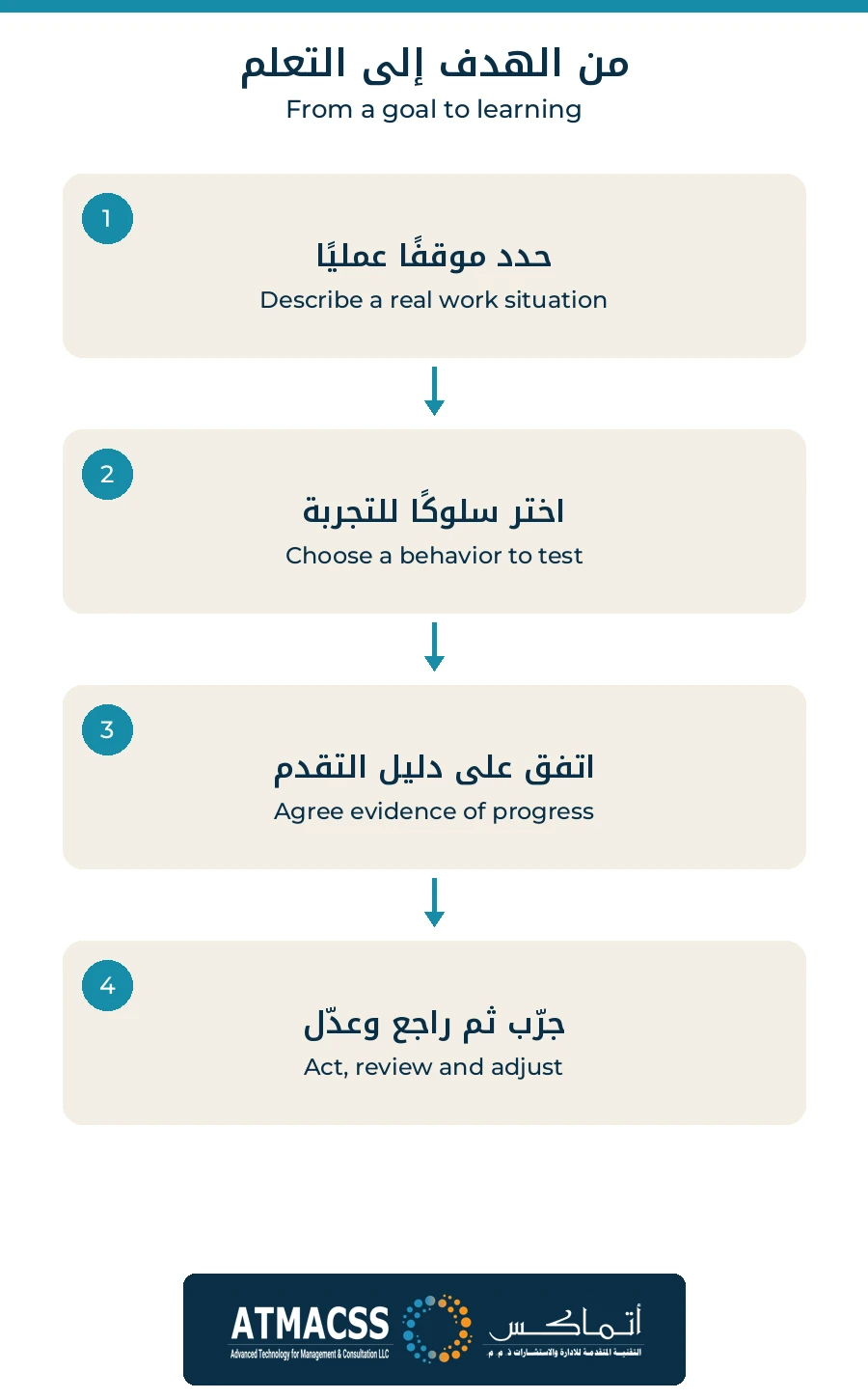
Replace “become a better leader” with a specific behavior in a real situation. A fictional department manager might want to delegate routine approvals within an agreed authority limit. A useful starting record would describe current approval delays, the manager’s interventions and the team’s understanding of responsibilities.
Agree what progress would look like. Evidence could include clearer task briefs, fewer unnecessary interventions and staff explaining when escalation is needed. Use feedback from others only with appropriate agreement. Avoid collecting personal information that does not help evaluate the goal.
Do not automatically attribute a change in revenue or employee turnover to coaching. Demand, staffing and operating changes may also affect those results. Report the observed behavior and the wider context separately.
Agree confidentiality before the first session
Clarify who is the client, who pays and what the sponsor may receive. When an employer funds coaching, the manager receiving it should understand what stays private. A sponsor might receive attendance and agreed progress information without receiving session notes.
The ICF Code of Ethics addresses agreements, confidentiality, conflicts and ending a coaching relationship. Use those subjects to structure the discussion. Record the purpose, responsibilities, fees, cancellation arrangements and limits of confidentiality. Ask where notes are stored, who can access them and when they are deleted.
Agree a short reporting format with the client and sponsor before work begins: the goal, review dates and specific progress information that may be shared. If the sponsor later requests session details or a new assessment, revisit the agreement before disclosing anything beyond its scope, subject to the stated confidentiality limits. Paying for coaching does not by itself define unrestricted access to the conversations.
If recording, transcription or an AI tool is proposed, discuss its purpose and data handling before use. A general consent to coaching should not be treated as permission for every additional technology.
Connect each session with a practical experiment
- Describe one recent situation using facts rather than labels.
- Examine assumptions and alternative responses.
- Choose an action within the client’s authority.
- Decide what evidence to observe.
- Review the result at the next session and adjust.
In the delegation example, the manager could agree the expected output and escalation limits before assigning one routine task. The next review would examine what happened, not simply whether the manager felt more confident. Keep the experiment proportionate to the consequences of a mistake.
Select a coach through evidence and a trial conversation
Check relevant experience, professional credentials where claimed and the provider’s ethical framework. Ask how the coach handles sponsor pressure, conflicts of interest and work beyond their competence. A credential provides information about a professional pathway; it does not guarantee a particular result.
Use an introductory conversation to assess listening, clarity and fit. Ask the coach to explain how a goal would be set and reviewed. Be cautious about guaranteed growth, pressure to buy a long package immediately or promises to solve every organizational problem through coaching.
A progress record that can be reviewed
Fictional example: A manager reviews 10 routine transactions within staff authority and identifies unnecessary intervention in 8. Define this behaviour before counting: taking back an authorised decision without a required escalation or a documented quality concern. Agree the boundaries with the team through the organisation’s normal authority arrangements; the coach cannot grant decision-making powers.
After practising a clearer task brief and escalation agreement, review 10 comparable transactions using the same definition. If unnecessary interventions fall to 3, the observed rate falls from 80% to 30%, a difference of 50 percentage points. These small samples indicate a change worth exploring, not proof of a lasting effect. Check errors, delays and whether required escalations still occurred; fewer interventions would not be progress if important exceptions were ignored.
Record the period, task type, observation and next action. At the next agreed review, decide whether to continue practising, clarify the process or use another form of support. Share only the progress information covered by the agreement, not private session details. This is a learning record, not independent proof that coaching caused improved organisational performance.
Review value and know when to stop
Set a review point at the outset. Continue when the goal remains useful and the client is applying learning. Adjust the approach when the barrier is a missing skill, unclear process or structural constraint. End the assignment when its purpose is met or another form of support is needed.
Coaching is not a substitute for qualified medical, legal or other specialist support. The coach should recognize limits and discuss an appropriate referral when necessary. The client should also be able to raise concerns or end the relationship under the agreed terms.
Begin with one work situation, the behavior to improve and the evidence you would accept as progress. Explore employee development and training to compare learning approaches, and corporate training and coaching when defining a potential assignment with ATMACSS.