


A feasibility analysis tests whether a proposed project is worth pursuing and can be delivered under stated assumptions. It should compare realistic alternatives, reveal evidence gaps and explain the conditions behind a recommendation. This article distinguishes financial and economic perspectives, outlines a practical study and shows how to test a business idea before committing substantial resources.
What does a feasibility analysis decide?
A useful study answers a specific decision: whether to launch, expand, redesign, pilot, postpone or stop a proposal. Define the customer need, intended output, location, period and decision owner before building a financial model. Otherwise, a detailed spreadsheet can produce a precise answer to the wrong question.
The term economic feasibility is often used broadly in business discussions. For clarity, distinguish the investor’s financial position from wider effects on society. A financially attractive project can impose costs on others. A project with wider public benefits can still need a sustainable funding arrangement. Neither perspective removes the need to test market demand or delivery capability.
| Perspective | Main question | Typical evidence |
|---|---|---|
| Market feasibility | Who needs the offer and will pay for it? | Customer research, alternatives and tested demand |
| Operational feasibility | Can the organization deliver the promised output? | Capacity, skills, suppliers and operating requirements |
| Financial feasibility | Can the project fund its obligations and justify its cost? | Cash flows, investment needs and financing assumptions |
| Economic appraisal | What are the wider costs and benefits of the alternatives? | Effects on affected groups, resources and external impacts |
The UK Treasury’s Green Book is a public-sector reference for appraisal. It is not an approval procedure for private businesses in the UAE. The relevant authority, financing conditions and legal requirements must be checked for the actual project. Do not import another jurisdiction’s approval steps into a general business study.
Compare options before choosing a model
Include a realistic baseline: what happens if the organization continues with its current arrangements? Then compare alternatives such as improving the existing process, using a partner, running a limited pilot or investing in a full operation. A comparison between an ideal project and an artificially weak baseline can make almost any proposal look attractive.
Record why options were included or rejected. Use comparable time periods, service levels and cost boundaries. If one option includes maintenance and another excludes it, resolve that difference before presenting totals. A study should make trade-offs visible rather than hide them behind a single score.
Test demand with evidence
Describe the intended customer, the problem, existing alternatives and the reason to change. Use interviews, observation, actual enquiries and carefully designed pilots where possible. Distinguish expressions of interest from commitments to buy. A positive response to an interview question does not establish a sales forecast or the price customers will accept.
The US Small Business Administration’s business planning guidance covers market research, competition and startup costs. These are useful general planning topics. For a UAE project, use locally relevant evidence and current supplier quotations. Record the date, source and limitations of each important assumption instead of presenting estimates as established facts.
Build the delivery and cash-flow picture
List the resources required to deliver the proposed volume and quality. Include setup work, equipment, people, premises, systems, supplier lead times and ongoing support. Review what happens if capacity grows in steps rather than smoothly. An extra sales order may require an entire additional shift, vehicle or licence instead of a small proportional cost increase.
Separate one-time investment, ongoing operating costs and working capital. Working capital includes cash tied up while customers have not yet paid and suppliers or staff must be paid. Profit and cash are different. A project can show an accounting profit while running short of cash because receipts arrive later than payments.
Set the forecast period and explain treatment of inflation, tax, financing and residual values. Use qualified input where those assumptions are material. Avoid counting the same expenditure twice, and keep the operating case distinct from how it is financed. Readers should be able to trace each major number to a source or clearly labelled assumption.
A simple break-even example
The following is an illustrative operating calculation, not a market estimate or investment recommendation. Suppose monthly fixed costs are AED 30,000, the price is AED 200 per unit and variable cost is AED 125 per unit. Contribution per unit is AED 75. The operating break-even volume is 30,000 divided by 75, or 400 units per month.
If the selling price falls to AED 180 while the other assumptions stay unchanged, contribution becomes AED 55. Break-even rises to about 546 whole units per month. This sensitivity shows why price evidence matters. It does not predict which price will occur. Record the assumptions that would make the project unacceptable before committing to it.
Add a capacity constraint: if practical capacity is 500 units per month, break-even at 546 units cannot be reached within the current operation. At a price of AED 180 and sales of 500 units, contribution is 500 × 55 = AED 27500. The operating result is 27500 − 30000 = −2500 AED per month, before the items excluded from this example. Raising the sales forecast above delivery capacity does not resolve the gap.
Examine explicit alternatives: support a higher price with customer evidence, reduce unit cost without harming quality, change fixed costs, or expand capacity after accounting for its cost. If expansion requires another shift, recalculate break-even with the new cost structure; do not retain the old operating cost while assuming greater capacity. Evidence of demand and funding for delayed collections remain separate conditions from a successful calculation.

Test uncertainty and wider effects
Sensitivity analysis changes one assumption to see how the result responds. Scenario analysis changes a coherent set of assumptions, such as delayed launch, slower sales and higher delivery costs. Avoid calling a scenario pessimistic unless its assumptions are explained. Test the variables that could alter the decision, not only the ones easiest to change.
Where benefits and costs occur over several years, present-value analysis accounts for timing. Explain the chosen discount rate and keep cash-flow and rate assumptions consistent. Do not treat a positive net present value as a guarantee. It remains a result under assumptions. Review unpriced effects separately, including who benefits and who bears an adverse impact.
Turn the study into a conditional decision
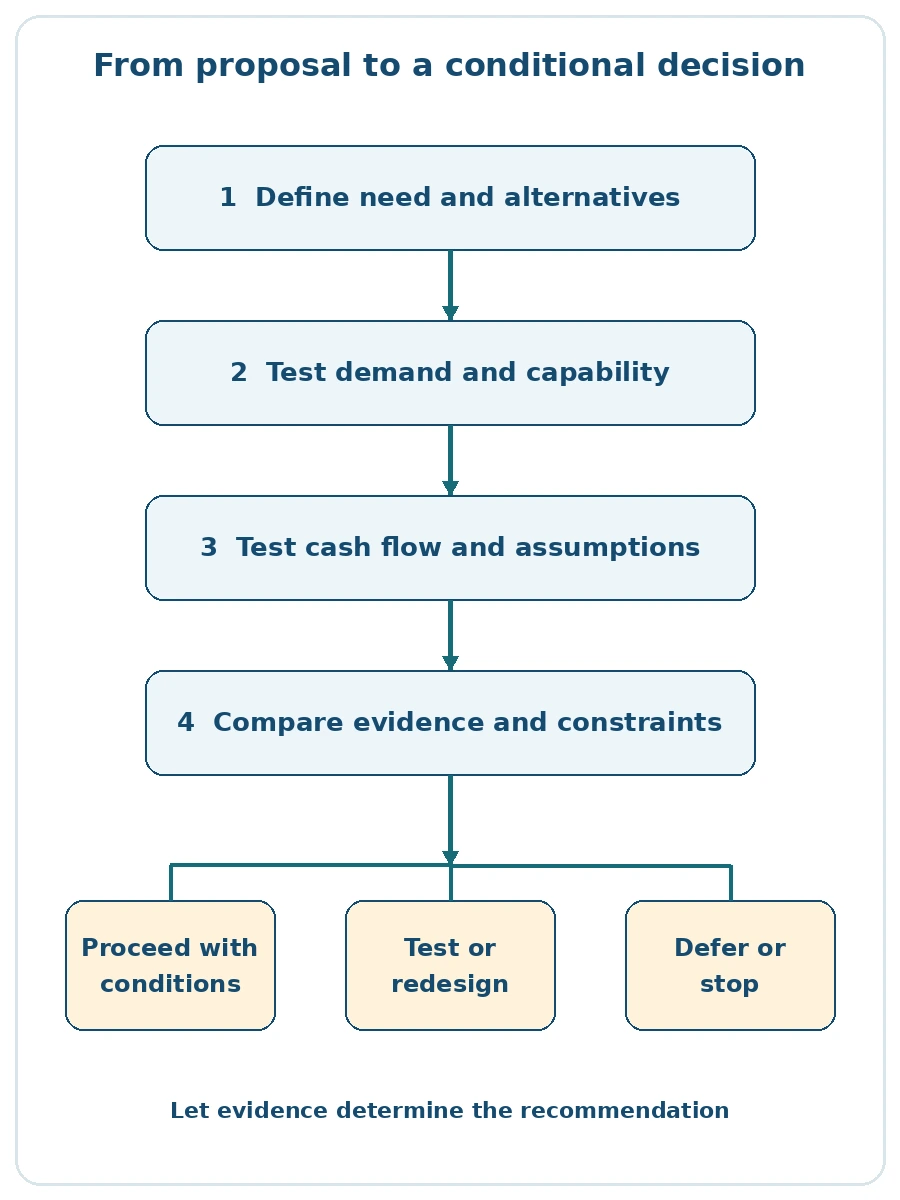
A recommendation should state the preferred option, evidence, remaining uncertainties, required funding and conditions for proceeding. A pilot may be the right next step when demand or delivery assumptions need testing. Define what the pilot must demonstrate, its spending limit and the evidence that would trigger expansion, redesign or stopping.
After approval, assign owners to the assumptions and milestones that matter. Compare actual results with the study and investigate material differences. Update the decision when evidence changes rather than defending the original forecast. The return on investment article explains another useful measure and its limits.
Discuss your proposal with ATMACSS
ATMACSS can discuss a defined assignment through business development and business and operations modeling. Bring the decision question, available market evidence, delivery assumptions and existing estimates. Agree the study’s boundaries and specialist inputs before work starts.
Contact ATMACSS about your project. A useful study may recommend proceeding, testing further, redesigning or stopping. Its value lies in making the decision and its conditions clear, not in producing a favourable result for every idea.