



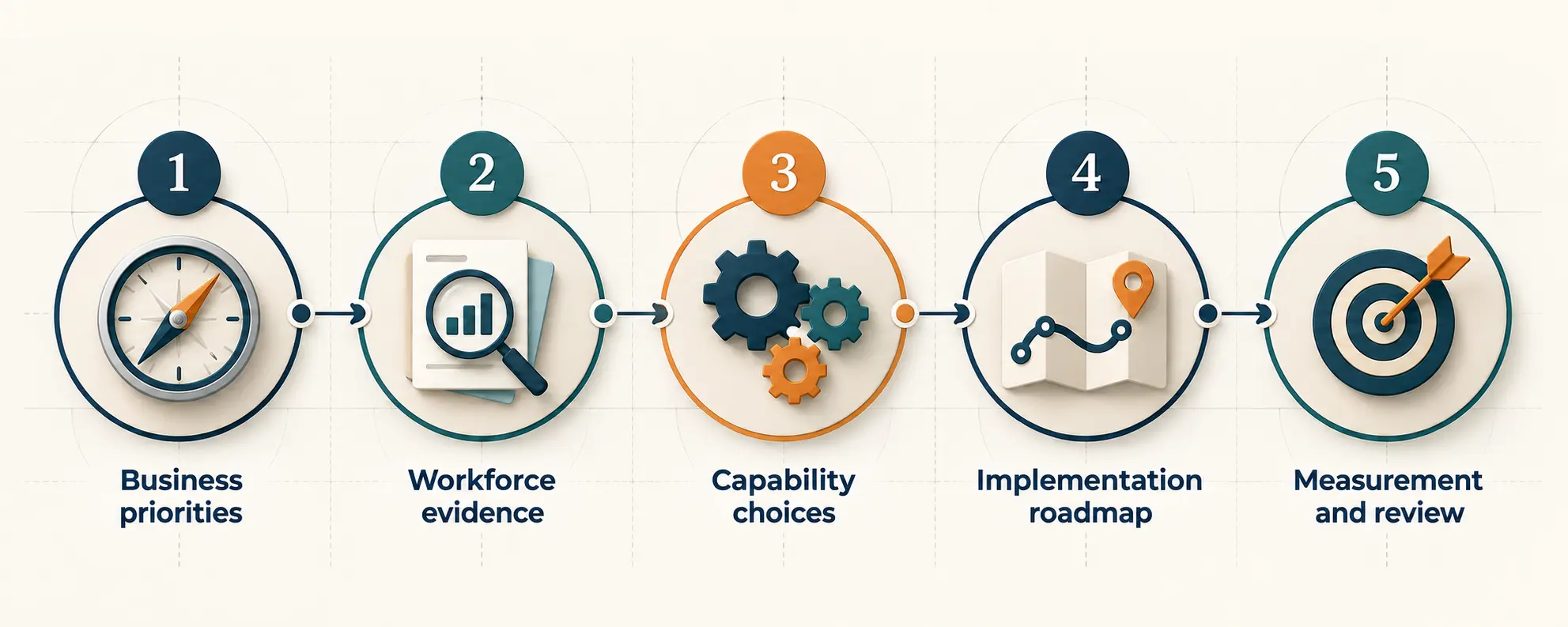
An organization may plan a new branch, but does it have the people, skills and leaders to operate it? HR strategy connects business goals with choices about people and work. This guide explains how to assess workforce needs, compare development and recruitment options, and turn those choices into a plan with owners, resources and measures of results, rather than activity counts alone.
What an HR strategy should contain
Start with what the organization wants to achieve. What work is required, who can perform it, and what is missing? A capability gap is the difference between what the work requires and the skills and delivery capacity currently available.
The organization identifies critical roles, how work and responsibilities are divided, and needs for leadership development, reward, working conditions and supporting systems. It then selects priorities it can fund and deliver. Distinguish outcomes from initiatives: reducing time to competence is an outcome; a training programme is one possible means.
What is the difference between HR strategy and the operating plan?
HR strategy sets the medium- and long-term choices the organization needs to deliver its direction, including critical capabilities, workforce model and leadership. The operating plan translates those choices into actions, dates, budgets and owners for a defined period. A plan may change when new evidence appears, while strategy should not change simply because one activity is late.
| Comparison | HR strategy | HR operating plan |
|---|---|---|
| Main question | Which capabilities and workforce does the organization need? | What will be done, when and by whom? |
| Time horizon | Medium or long term | A defined delivery period, often annual or phased |
| Outputs | Choices, priorities and decision principles | Initiatives, dates, resources and measures |
| Reason to update | A material change in organizational direction or context | Delivery results or changes in resources and timing |
Start with evidence, not programmes
First review expected workload and required service levels, then available people, skills and hours. Headcount differs from time available for delivery: leave, training and other duties affect practical capacity.
Also examine employee departures, recruitment time, workforce cost and feedback from employees and managers. Compare functions or occupations when their needs differ, and test impressions against reliable records. Document missing data and assumptions. Consider higher- and lower-demand scenarios instead of relying on one forecast.
Employee turnover means employees leaving the organization during a defined period. Separate voluntary departures from other exits, and examine patterns by role and team. Compare exit feedback with workload, reward, development opportunities and management practices; one interview rarely establishes a cause. Choose an action with an owner and review date, then check whether avoidable departures decline without harming service or fairness.
Translate priorities into workforce choices
For each business priority, ask what work will change, which capabilities become critical, where capacity is constrained, and whether the organization should build, buy, borrow or automate capability. Define a small number of strategic themes such as workforce planning, leadership succession, critical-skill development or HR service redesign. State what will not be prioritized to protect focus.
Succession planning prepares people to fill business-critical roles when someone leaves or changes position. Start with the responsibilities and capabilities the future role requires. Distinguish immediate cover from longer-term development, and assess readiness through relevant assignments, supervised practice and feedback. Review candidates against clear, consistent criteria. Inclusion in a development plan is not a promise of promotion, and a named successor is not evidence of readiness.
Build a controlled implementation roadmap
Sequence initiatives by value, risk and readiness, showing what must happen first. For example, agree which skills matter and how to assess them before selecting a skills system. Give each initiative an owner, budget, deadline, intended result and review point.
Leadership approves priorities and resources. HR coordinates the plan and data. Department managers define work requirements and implement changes, while finance reviews affordability. Explain changes to employees and hear their feedback. Test uncertain interventions on a limited scale before wider rollout.

Measure outcomes and refresh the strategy
A key performance indicator (KPI) connects measurement to a defined objective. Specify its definition, formula, unit, baseline, target, source, owner and review date.
Combine early signals, such as the share of employees who demonstrate a required skill, with later outcomes, such as fewer service errors. Training attendance is an activity. Performing a task to an agreed standard is an outcome that needs testing. Monitor quality and workload alongside speed so improvement does not come at employees’ or customers’ expense.
A monthly delivery review and quarterly review of strategic assumptions may be useful, with earlier reviews after significant changes. Choose a frequency suited to the work and revise priorities when assumptions or resources are no longer realistic.
Common failure modes
Frequent problems include copying generic best practice, treating every HR activity as strategic, ignoring line-manager capacity, launching technology before process design, and using employee surveys without acting on findings. Another failure is measuring activity volume instead of business-relevant outcomes.
Governance, fairness and data protection
People decisions need clear authority, published criteria and an auditable record. Collect only necessary data, define retention and access, and review the effect of practices across relevant groups where lawful. Automated tools may support judgement, but speed alone is not a reason to delegate accountability to a system.
Hypothetical example: translating demand into workforce capacity
Suppose a service unit expects 1200 requests a month, averaging 0.5 hours of active work per request. Demand is 1200 × 0.5 = 600 hours a month. These are teaching assumptions, not productivity benchmarks or client data.
If each employee has 120 hours a month available for these requests, after leave, training and other duties, the requirement is 600 ÷ 120 = 5 full-time equivalents. A full-time equivalent (FTE) measures time capacity and may differ from the actual number of people.
Current capacity of 4 FTE provides 480 hours, leaving a gap of 120 hours a month. This does not automatically mean hiring someone. The team examines demand patterns, skills, approvals and rework. Options include developing and transferring an employee, recruitment, temporary support or process improvement.
Suppose the team chooses to train an employee who can transfer within 3 months without disrupting the original unit. Management approves resources, HR coordinates training and the service manager tests competence using practical cases before transfer. The team measures available capacity after qualification and monitors late requests, errors and overtime monthly.
Recalculate if demand or handling time changes. Peaks, skill differences and shift coverage may require additional capacity. A monthly average is an initial estimate, not a service-level guarantee or a stand-alone justification for hiring.
How do you choose between build, buy, borrow and automate?
No single option suits every capability. Build internally when a capability is core, recurring and depends on accumulated organizational knowledge. Hire when the need is continuing and the role can be defined clearly. External support is useful for specialist or temporary needs, provided knowledge, confidentiality and supplier dependency are controlled. Automation fits repeatable work when data, controls and human review are sufficient.
For core capabilities the organization needs continuously.
For continuing demand with a clear role and a suitable talent market.
For temporary demand or expertise that does not justify a permanent role.
For repeatable work after data, risk and review controls are in place.
Options can be combined. An organization may use an expert to design an approach, develop its team to operate it and automate a repeatable part. A sound decision balances value, speed, cost, risk and continuity, then sets a review point to confirm that the choice remains suitable.
Implementation checklist
- A clear outcome and documented baseline
- An accountable owner and decision rights
- Data sources and quality controls
- Risks, assumptions and stop criteria
- A review schedule and evidence of impact
For broader context, explore the role of human resources and AI applications in business where relevant.
Conclusion
Start with a clear business priority, then estimate the work, skills and available capacity. Compare options, assign resources and responsibilities, and test results before expanding. HR strategy is an ongoing choice about what the organization needs and how to provide it. Better evidence and participation from managers and employees improve those choices. For support in structuring this work, contact ATMACSS.