



A marketing campaign coordinates a message, an audience, activities and a defined period around a particular objective. For a business in the UAE, the practical challenge is to connect those activities to a customer action the team can measure and serve. Start with that action before choosing channels or commissioning creative work. This article covers the brief, launch readiness, result reconciliation and following through on commitments after the campaign ends.
Distinguish the campaign from the strategy
Marketing strategy sets longer-term choices about customers, positioning and how the business competes. A campaign carries out a defined part of that direction. Advertising is one possible campaign activity; a campaign may also use events, owned content, email or sales follow-up.
For a fictional training provider, “become better known” is a broad ambition. A campaign objective could be to generate qualified enquiries for a specific workshop during a stated booking period. Qualification would need a definition, such as relevant need, suitable audience and an achievable delivery date.
Write the brief as a series of decisions
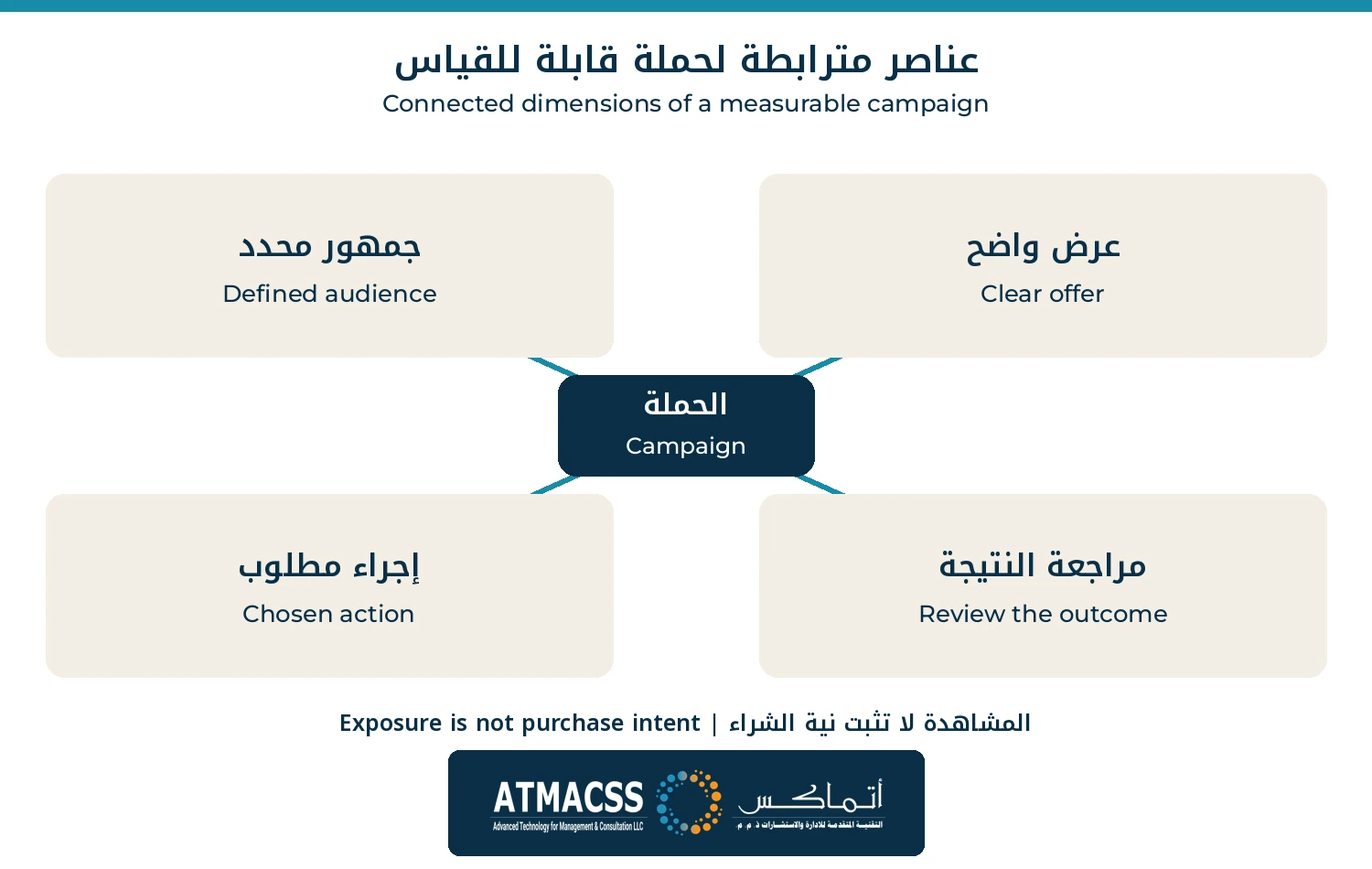
- Audience: identify the people facing the problem and those approving a purchase.
- Need: describe the situation that makes the offer relevant now.
- Offer: state what is included, its conditions and the supporting evidence.
- Action: choose the next step, such as a booking or a qualified enquiry.
- Capacity: confirm who responds and what the business can actually deliver.
For Arabic and English audiences, preserve the offer and conditions while adapting the wording naturally. Do not assume that every customer in the UAE uses the same language or responds to the same channel. Use customer evidence and limited tests to choose the approach.
Connect the message to a complete journey
A persuasive advertisement can fail if its landing page contradicts the offer or the enquiry receives no response. Map the journey from exposure through the chosen action to follow-up. Check that price information, eligibility, dates and contact details remain consistent.
Choose channels because of audience access and suitability for the decision. Search may reach an expressed need; an event may allow a complex offer to be discussed. These are hypotheses to test, not universal rules. Avoid spreading a small budget across more channels than the team can maintain.
Choose measures that answer different questions
| Question | Possible measure | Limit |
|---|---|---|
| Was the message seen? | Reach or impressions | Exposure does not establish intent |
| Did people take the next step? | Landing-page actions | An action may be low quality |
| Did suitable prospects respond? | Qualified enquiries | Qualification must be consistent |
| Did the campaign create value? | Attributed sales and contribution | Attribution may omit other influences |
Record the baseline and tracking method before launch. Cost per qualified enquiry equals the defined campaign cost divided by qualified enquiries. State which costs are included. Do not confuse revenue with profit or treat every reported platform conversion as an additional customer.
Use a launch checklist and a limited test
- Test the form, confirmation message and mobile page.
- Verify every link, language version and offer condition.
- Confirm that claims, imagery and permissions are supported.
- Review applicable advertising and personal-data requirements.
- Assign a person to enquiries, complaints and urgent corrections.
- Set a spending limit and conditions for pausing the campaign.
Collect only data needed for the stated purpose and obtain the appropriate permissions for its use. A purchased contact list is not evidence of permission. Requirements depend on the activity and applicable rules; obtain specialist review where necessary.
A completed campaign brief and calculation
- Fictional campaign
- A workshop for HR managers with an identified training need and authority to arrange discovery.
- Period and budget
- 4 weeks and AED 6,000 in total direct campaign costs, including advertising and dedicated content.
- Ownership
- The marketing owner monitors delivery; the sales owner qualifies enquiries and updates the record.
- Review criterion
- At least 20 qualified enquiries, sufficient follow-up capacity and a plausible economic path to paid work.
If 40 enquiries arrive and 20 qualify, cost per qualified enquiry is AED 6,000 ÷ 20 = AED 300, not AED 150. This does not establish profitability: review resulting contracts, their contribution and additional selling costs. These figures illustrate the method; they are not market benchmarks.
The count target is met at 20 qualified enquiries, but that is only one acceptance criterion. Suppose 4 of those enquiries later become paid contracts, each contributing AED 1,000 after direct delivery costs and before campaign and additional selling costs. Their combined contribution is AED 4,000. After the AED 6,000 campaign cost, the balance is negative AED 2,000 before any additional selling costs. Meeting the enquiry target therefore does not establish a positive return. This simplified example excludes other costs and does not prove that the campaign caused the contracts.
If no enquiry qualifies, cost per qualified enquiry cannot be calculated by dividing by zero. Report the spending and 0 qualified enquiries explicitly, then investigate the offer, targeting, tracking and qualification process. Do not display a zero cost as though acquisition were free.
Reconcile platform results with the enquiry record
Establish what the platform calls a conversion before reporting it. A conversion might be a form submission or a click on a call button. The team needs to know which enquiries were actually received and qualified. Agree how events can be connected to cases without collecting unnecessary information, and state the limits of available tracking.
In a fictional example, a platform reports 30 form submissions. The team identifies 5 internal tests and 3 duplicate messages. That leaves 22 unique cases to review, not automatically 22 qualified opportunities. Record exclusions and qualification reasons, using the same definitions in the next comparison. Reconciliation helps explain the figures without treating a dashboard as the final sales record.
Agree the reporting cut-off and a follow-up window before launch. Keep enquiries received during the campaign as a defined group and update their later outcomes without counting the same case again. A contract signed after the campaign ends may belong to this group, but report its conversion date and attribution basis. Keep pending cases separate from won and lost cases; changing the observation window between campaigns can distort comparisons.
Also examine cases missing from platform reporting, such as a caller who mentions the campaign. Classify the source using available evidence rather than forcing every sale into one channel. Several contacts may contribute to a decision. Show unknown sources openly instead of allocating them through an undisclosed estimate.
Close the campaign while following through on commitments
At the period’s end, check scheduled advertisements, offer pages and automated messages. Update material whose conditions have expired and explain what customers can do now. Stopping expenditure does not end responsibility for an enquiry received during the campaign or a commitment already made.
- List open enquiries with an owner and follow-up date.
- Reconcile actual spending with the budget, identifying items not yet invoiced.
- Separate confirmed outcomes from results that need more time.
- Retain approved materials and reasons for changes under the retention policy.
Finish with a short discussion involving marketing, sales and delivery. Ask what attracted suitable customers, where the journey failed and which change deserves another test. Do not generalise one campaign’s result to every season or audience. Use the lesson to revise the next brief and the capacity needed to deliver it.
Change one meaningful variable and record the lesson
Begin with a manageable test and a review date. Compare results using equivalent definitions and enough observation to avoid reacting to isolated events. If enquiries are plentiful but unsuitable, investigate targeting and the promise before increasing spend.
Record what ran, what it cost, what happened and what remains uncertain. Decide to stop, revise or expand on that evidence. The next practical step is a one-page campaign brief, followed by a delivery and measurement check. Connect the campaign to your wider business development priorities.