



A near miss can reveal a weakness before someone is harmed. Learning from it requires more than recording that no injury occurred or reminding people to be careful. A proportionate investigation establishes what happened, examines the conditions that allowed it and verifies whether the chosen controls reduce the risk of recurrence.
Protect people and preserve the facts
A near miss is an event that caused no injury or ill health but had the potential to do so. For example, a vehicle might pass close to a pedestrian without striking them. The absence of injury does not remove the need to understand why their routes came so close.
Use the organisation’s emergency and reporting procedures first. Keep people away from an uncontrolled hazard and involve competent personnel. Do not recreate a dangerous event to obtain evidence. Preserve relevant information when safe to do so and follow applicable reporting obligations.
Investigate according to potential severity as well as actual outcome. The ISO 45001 overview explains the wider occupational health and safety management context. This article is a management learning sequence, not site-specific safety instructions.
Define the investigation and evidence record
Before collecting a large volume of information, define the question the investigation must answer, who will lead it and who will review its findings. Set its scope with regard to potential harm, recurrence and complexity, alongside applicable procedures and requirements. An event without injury may warrant more attention than a minor injury if it reveals a serious exposure. Competent personnel should assess that context rather than rely on the number of reports.
Keep a brief record for each item of evidence: its source, when it was obtained, what it establishes and its limitations. A photograph may show materials in a walkway without establishing when or why they were placed there. An employee’s account may describe their own view without resolving the complete sequence. Where accounts differ, record the difference and seek independent information rather than selecting the most convenient explanation.
When investigating a warehouse event, compare accounts with storage arrangements, instructions available at the time and relevant inspection records. Distinguish the written procedure from actual practice. If a crucial fact remains unknown, explain how that uncertainty affects the conclusion and preventive decision, and assign responsibility for following it up. Necessary protection should not wait for a complete report.
Build a factual sequence
Record the task, location, equipment, people involved and sequence before, during and after the event. Gather accounts promptly and respectfully. Separate what a person directly observed from what they inferred or heard later. Note uncertainty rather than filling gaps with assumptions.
In a hypothetical example for illustration, set in a warehouse, a pedestrian steps into a vehicle route when a marked walkway is blocked by stored items. The investigation needs to establish the actual layout, visibility, traffic, storage decision and working conditions. The absence of injury does not demonstrate that the arrangement was safe.
Look beyond the last visible action
Examine immediate conditions and the wider arrangements that produced them. Why was the walkway obstructed? Was there a suitable storage area? Who checked the route, and could staff report an obstruction and obtain a timely response? Consider workload, layout, maintenance and supervision alongside individual actions.
HSE’s investigation guidance encourages learning from incidents and identifying preventive action. Avoid treating “human error” as a complete explanation. Equally, do not invent a single root cause when the evidence shows several interacting factors. Record the causal explanation and the evidence that supports each part.
Choose controls matched to the cause
Consider whether the hazard can be eliminated or the exposure reduced through safer design and physical separation before relying only on reminders. A competent safety assessment should determine the appropriate controls for the site.
- Describe the risk and the cause being addressed.
- Specify an action that can be implemented and checked.
- Assign an owner, deadline and required resources.
- Define interim protection while permanent action is pending.
- State how effectiveness will be verified.
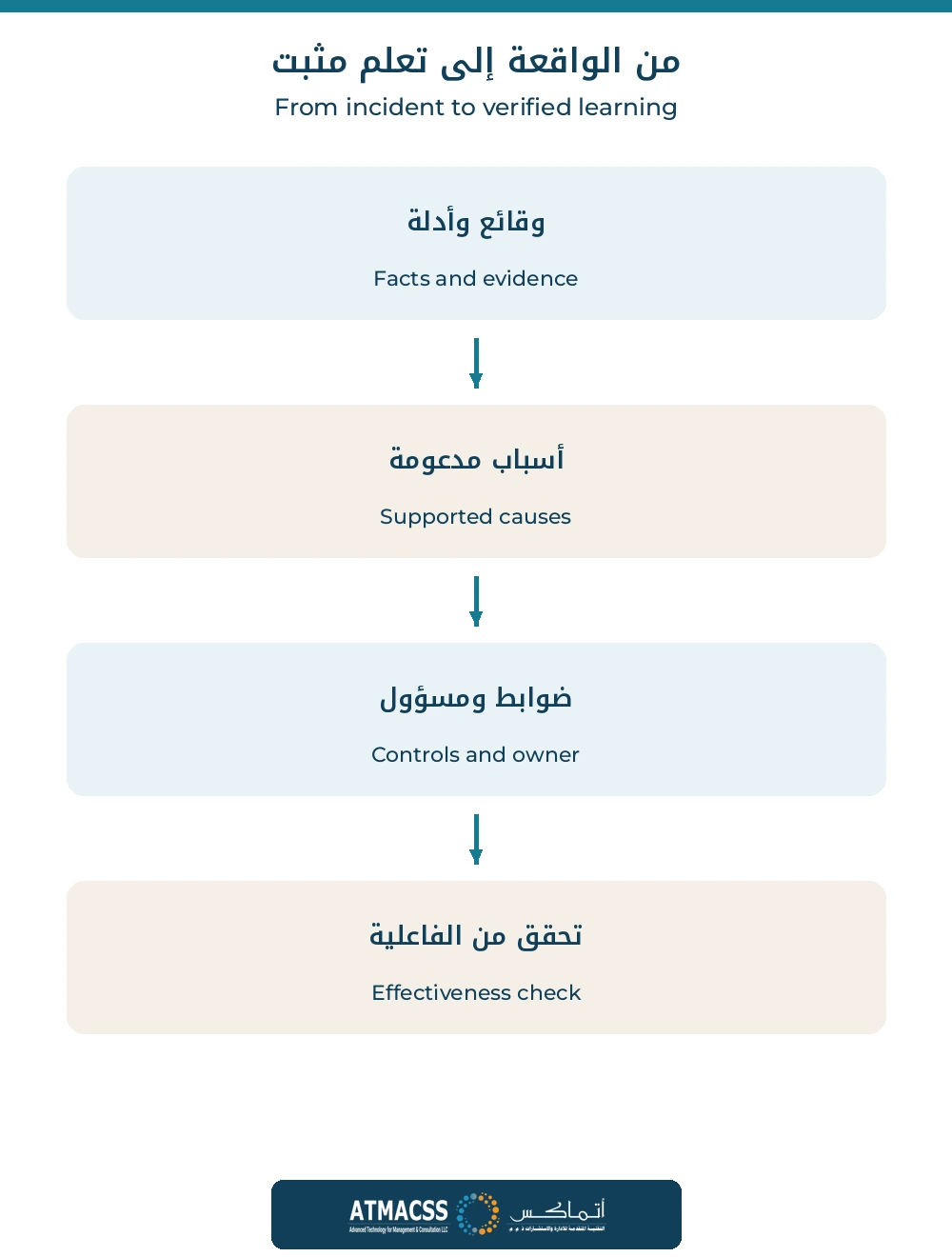
A correction addresses the existing problem; clearing the walkway in the example removes the immediate obstruction. Corrective action addresses the causes to prevent recurrence. Preventing recurrence may also require a workable storage arrangement and a route inspection and escalation process.
Check effectiveness, not just completion
A photograph of a cleared walkway proves a condition at one moment. It does not establish that the problem will stay resolved. Check the route under relevant operating conditions and ask whether the new arrangement creates another exposure. Confirm that affected workers understand how to raise concerns.
Choose follow-up evidence appropriate to the risk. Record unresolved issues and escalate overdue controls. Do not close an action merely because training occurred or a document was issued. Closure should explain why the agreed control is in place and how its effectiveness was assessed.
Interpret reporting measures carefully
More near-miss reports may reflect greater confidence in reporting, increased exposure or a changed definition of what is recorded. The count alone therefore does not establish improving or deteriorating safety. Equally, no reports do not prove that hazards are absent: the reporting route may be unclear or previous responses may have discouraged its use.
Review figures alongside activity levels, task types and changes in recording practice. Separate actions implemented from actions whose effectiveness has been assessed. Explain what remains open and why. Management might track recurring walkway obstructions and responses to reports while interpreting both in their operating context. The purpose is to direct investigation and improvement, not encourage concealment to achieve an attractive number.
Fair learning protects the accuracy of accounts and examines working conditions without removing accountability. Any response to individual conduct should follow verified facts and applicable organisational procedures, without public accusations or prejudgment.
Share useful learning without blame
Share the task conditions, control weakness and agreed changes with teams exposed to a similar risk. Protect personal information and avoid presenting unverified allegations as facts. A useful learning note enables another team to recognise the condition and check its own controls.
The learning cycle is complete when facts connect to causes, causes to specific actions, and actions to evidence of effectiveness. Review one completed investigation: can you trace these connections? Where a gap remains, assign an owner and review date instead of declaring success before checking the result.
The ISO Implementation and Certification support service can connect incident learning with management-system processes. Certification does not guarantee an incident-free workplace or replace legal duties.