



Social media marketing uses relevant content, interaction and distribution to reach a defined audience and support business objectives. Publishing frequently is only one part of the work. This article explains how to connect audience needs, content choices, response ownership and measurement. It also shows how to test activity without confusing visibility, engagement and actual customer outcomes.
Define the outcome before choosing a platform
Identify what the activity should help achieve. An organization might need suitable enquiries, better understanding of a service or support for an existing customer relationship. These objectives require different content and measures. A target to “increase engagement” is incomplete until the team explains why that engagement matters.
Define the audience through its needs, questions and decision context. Do not assume that everyone interested in a broad industry is a suitable customer. Identify who influences the purchase and what information they need at each stage. The target market article provides a related starting point.
Choose platforms based on evidence about the audience and the team's ability to maintain useful participation. Verify current platform features before relying on them. Opening many accounts can create inactive channels and unanswered messages if responsibilities and capacity are unclear.
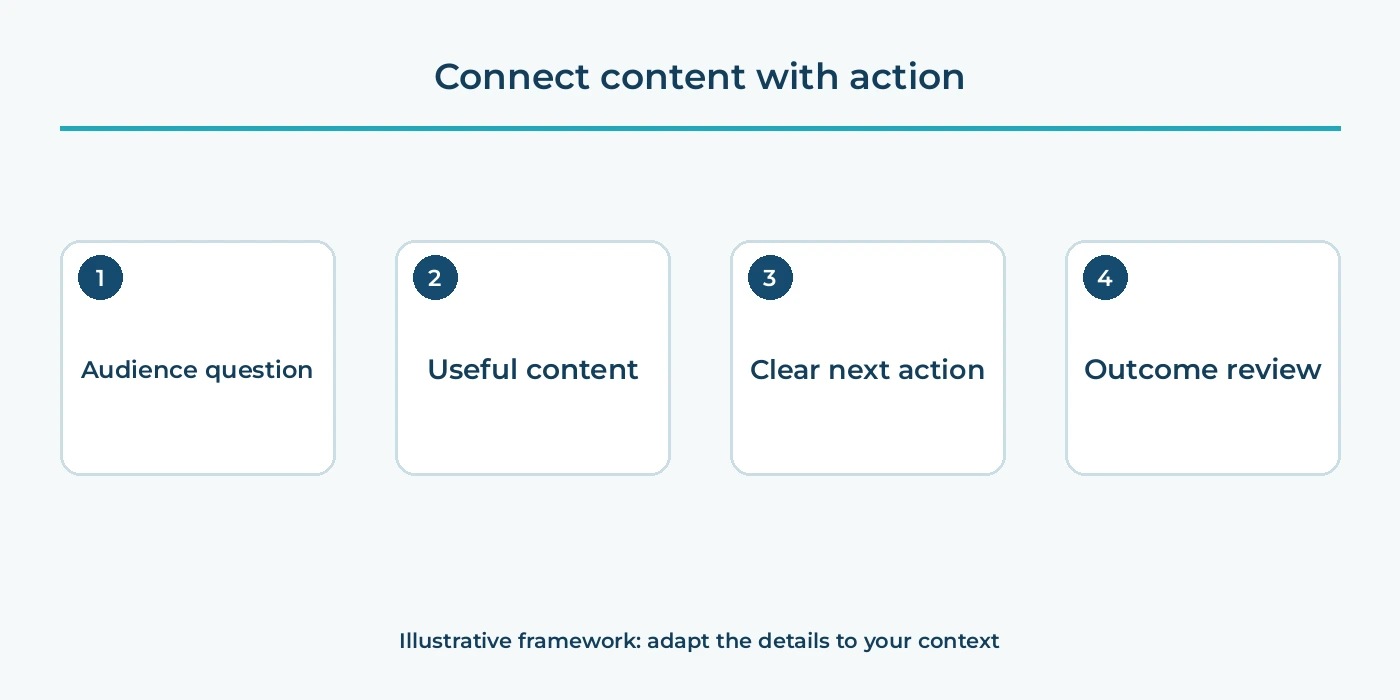
Build content around real questions
Collect questions from customer conversations, service enquiries and delivery teams. Group them by the decision they help someone make. A practical explanation, a comparison and an example of a process can serve different needs. Avoid turning every post into the same promotional message.
For a fictional training provider, content could explain how to define a learning need, how to prepare participants and how to assess workplace application. These topics help a prospective customer understand the service. They should not imply that attendance automatically produces a measurable business improvement.
Create a brief for each item: audience, question, main point, supporting evidence and next action. A clear brief makes review easier and reduces the temptation to add unsupported statistics or vague promises simply to make the post more persuasive.
Match the format to the information
Use a short text explanation for a focused point, a diagram for a process and a comparison when the reader needs to distinguish alternatives. A video can demonstrate an action that is difficult to explain in still images. The format should earn its place by improving understanding.
Make essential information available beyond the image alone. Use readable text, appropriate alternative descriptions and captions for spoken content. Review the result on the devices people actually use. A detailed diagram that is unreadable on a phone does not become useful because it looks attractive on a large design canvas.
| Content purpose | Suitable approach | Useful next action |
|---|---|---|
| Explain a concept | Clear definition and example | Read a relevant article |
| Compare alternatives | Focused comparison | Assess the reader's situation |
| Demonstrate a method | Process illustration or demonstration | Try a defined step |
| Introduce a service | Scope, fit and boundaries | Discuss requirements |
Establish review and response ownership
Assign who prepares, checks and approves content. Identify claims that require evidence and material that needs permission. Keep the approved wording and source record. A fast publishing schedule is not a reason to present an illustrative result as a real customer outcome.
Define who responds to comments and enquiries, how suitable opportunities are passed to the responsible person and when issues are escalated. Avoid asking people to disclose sensitive details publicly. Move individual matters to an appropriate private channel without promising a response the team cannot provide.
Plan for corrections. If a post contains an error, assess its effect and correct it clearly. Update linked material where necessary. Removing an inaccurate claim from one post does not resolve the problem if the same claim remains in a downloadable document or scheduled content.
Connect organic activity and paid distribution
Organic activity and paid distribution are different ways to reach people. Each still needs a useful message and a suitable destination. Increasing distribution will not fix an unclear offer or a broken enquiry form. Check the destination before committing resources to promotion.
For paid tests, define the intended audience, spending boundary, duration and success criteria before launch. Assign someone to monitor the activity and stop it when conditions are not met. This article does not prescribe a budget; the appropriate amount depends on the business case and available resources.
Keep experiments interpretable. If the audience, message, format and destination all change together, it becomes difficult to understand the cause of a result. Choose a test that answers a practical question and document the variables that changed.
Measure the path, not one headline number
Distinguish reach, engagement, visits, enquiries and qualified opportunities. Each describes a different point in the path. A post can attract many reactions while generating little relevant interest. Conversely, a narrowly targeted explanation may reach fewer people but help suitable customers take a useful next step.
Define how outcomes are recorded and avoid double counting the same enquiry across channels. Use consistent campaign labels where appropriate and respect applicable privacy requirements. Attribute results cautiously when several interactions contribute to a purchase.
Illustrative example: during a 4-week campaign, the team records 20 unique enquiries. Of these, 8 qualify under an agreed definition: a clear need within the service scope, a contactable person and an accepted follow-up step. The qualification rate is 8 ÷ 20 × 100 = 40%. Against a target of 50%, this is 10 percentage points below target; it does not mean 40% of the audience bought the service. Show enquiries still awaiting assessment separately rather than automatically classifying them as unqualified.
If advertising spend in this example is AED 1200, advertising spend per qualified enquiry is 1200 ÷ 8 = AED 150. This is neither customer acquisition cost nor the full cost of marketing: it excludes content preparation and follow-up time, and an enquiry is not a completed sale. When no enquiries qualify, report that fact and the spend rather than dividing by zero. These figures are educational assumptions, not a market benchmark or a promised result.
To use a measure as a key performance indicator, KPI, connect it to an objective, target, measurement period, stable definition, data source and responsible owner. The marketing owner reviews the enquiry record with sales, removes duplicates, compares the result with the target and documents the action. Record quality remains essential to interpreting the rate, especially with a small sample.
Review content quality alongside numbers. Read the questions people ask, inspect the suitability of enquiries and discuss what happens after handover. A low conversion rate may reflect poor audience fit, an unclear next step or slow follow-up. The platform metric alone cannot identify the cause.
Use a manageable review cycle
Choose a focused set of topics and publish at a pace the team can sustain. Review what was learned, which content remains useful and what should change. Reuse an explanation only when it remains accurate and relevant; do not repeat it automatically to fill a calendar.
Use Plan–Do–Check–Act, PDCA: define a question and target, run a limited test, review results and feedback, then change a clearly identified element and measure again. If many enquiries are unsuitable, review service-scope clarity and targeting. If suitable enquiries receive slow follow-up, fix handover and ownership before increasing promotion.
The marketing strategy article connects channel activity with broader choices. Business development support can help clarify the opportunity and handover process. Start with one audience question, one useful piece of content and one working next action, then evaluate the complete path before expanding the programme.