



A strategic partnership connects organisations around a shared objective that each would find harder to achieve alone. It can combine capabilities, market access or delivery resources. A promising introduction is only the beginning: the partnership also needs a sound commercial purpose, clear responsibilities and a workable way to resolve disagreement. This guide explains the decisions to make before expanding a collaboration.
Define the gap the partnership should address
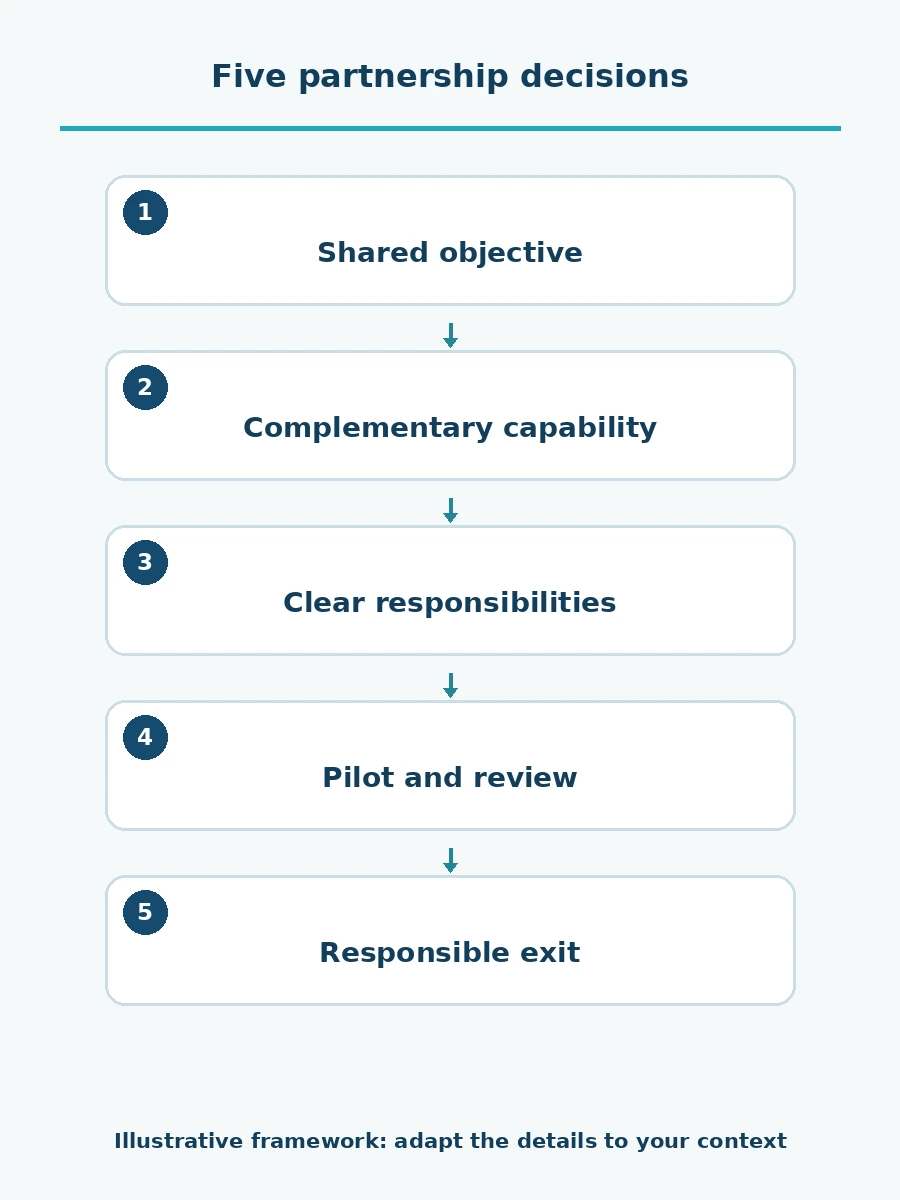
Start with your business objective and the capability or access you lack. You might need a specialist delivery partner, a distribution route or complementary expertise. Describe the intended customer benefit and the activities that require collaboration. If the objective is simply to announce a partnership, there may be little operational substance to sustain it.
Compare partnering with other options, including building the capability internally, buying a defined service or narrowing the offer. A partnership introduces coordination work and dependence as well as potential benefits. Write down why collaboration is appropriate and what would make another option preferable.
Distinguish the relationship from its label
Referral arrangements, reseller agreements, joint delivery and joint ventures can involve very different responsibilities. The word “strategic” does not establish who can make commitments, own customer relationships or use another organisation’s brand. Describe the intended arrangement in practical terms before choosing the announcement language.
ISO 44001 provides a management-system framework for collaborative business relationships. Its existence does not mean every partnership needs certification. For a specific arrangement, proportionate governance begins with the actual scope, risks and responsibilities. Obtain appropriate professional advice for contractual, regulatory or structural questions.
Screen for complementary capability
Build a shortlist against explicit criteria. Relevant experience matters, but check whether the organisation can provide the people, systems and capacity needed for this particular work. Ask for evidence that can be appropriately shared, and distinguish verified information from sales claims.
Consider compatibility in quality expectations, decision speed, customer service and ways of working. Two capable businesses may still struggle if one promises rapid customisation while the other depends on a fixed delivery process. Discuss likely friction before committing to a combined offer.
A practical partner assessment
| Area | Question to resolve | Evidence to seek |
|---|---|---|
| Customer value | What improves for the customer? | A defined use case and offer |
| Capability | Can the partner deliver the agreed scope? | Relevant experience and available resources |
| Commercial logic | How are effort, income and costs allocated? | A transparent commercial model |
| Governance | Who decides and resolves exceptions? | Named owners and escalation arrangements |
| Continuity | What happens if delivery is interrupted? | A credible handover or contingency approach |
Avoid a total score that conceals a critical weakness. A strong market network does not compensate for an inability to deliver a core obligation. Record any conditions that must be satisfied before a pilot or full launch can proceed.
Agree responsibilities before introducing customers
Define the scope, deliverables, acceptance criteria and responsibilities at each handover. Establish who can approve changes and communicate commitments. Where both organisations interact with the customer, agree a consistent explanation of the service and a clear route for complaints.
Address the use of information, intellectual property, brand assets and customer data in the appropriate agreement. Commercial arrangements should explain payment triggers and the treatment of additional work. Do not leave these matters to a future discussion after the first disagreement has already affected a customer.
For example, if the training provider gathers participant information for the process specialist, agree the handover contents, deadline and person who accepts it. Sending a file does not complete the handover if required information is missing. The recipient checks the completeness of information authorised for sharing, records gaps and returns the request to a named owner rather than passing confusion to the customer. If the customer requests a new output during delivery, neither partner should promise it before its effort, cost and timing implications are assessed and approved under the agreed authority.
Pilot the relationship under realistic conditions
A limited pilot can test how the organisations work together without assuming that a successful meeting proves delivery compatibility. Select a scope that is useful but manageable. Set a review date and decide what evidence will support continuation, revision or closure.
For example, a fictional training provider and a process specialist might jointly deliver a small improvement programme. The pilot could examine handover quality, attendance arrangements, the usefulness of outputs and the effort required from both teams. This is an illustrative design, not a reported ATMACSS project or a guarantee of commercial success.
Measure the shared outcome and the working relationship
Use a small set of measures connected to the partnership objective. These might cover completed deliverables, accepted outputs, response to issues or customer feedback. Separate activity measures, such as meetings held, from evidence that the collaboration is producing the intended result.
Review the relationship itself: are decisions timely, information reliable and commitments realistic? Encourage early escalation of problems rather than rewarding an appearance of harmony. A regular joint review can identify changes in capacity, priorities or market conditions that make the original arrangement unsuitable.
Plan a responsible exit
Define how either party can raise concerns, propose changes or end the arrangement under the agreed terms. Consider unfinished work, customer communication, access permissions, records and brand use. An exit plan is part of responsible relationship management, even when both parties expect a long collaboration.
Turn the exit plan into assigned, dated actions: list open obligations, identify who completes each job and communicates with the customer, and verify that the replacement delivery team accepts the handover. Address outstanding payments and disputes under the agreement, and decide how data, files, usage rights and retention requirements will be handled. Do not disable operational access before arranging service continuity, or leave unnecessary permissions after the transition. Both parties record what is complete and what remains open; announcing the end of the partnership does not demonstrate that every obligation is closed.
Keep a decision record and update it as the partnership changes. Do not allow an informal expansion of scope to create responsibilities that neither organisation has assessed. Material changes may require revised agreements, resources and customer communications.
Develop a partnership brief with ATMACSS
Bring your growth objective, capability gap and proposed partner profile to a discussion about Business Development with ATMACSS. A focused brief helps separate a commercially useful collaboration from an attractive but undefined opportunity. The business modelling guide can help clarify how the partnership fits the wider delivery and revenue model.