



A value proposition explains why a particular customer should consider your offer for a particular need. It connects the promised benefit with a credible reason to believe it. This article shows how to build that connection, test the wording and the offer separately, and avoid claims that sound impressive but do not help a customer make a decision.
A value proposition is more than a slogan
A value proposition describes the value an offer is expected to create for a defined customer. It should identify the relevant need, the outcome offered and the reason the offer is a suitable choice. A slogan may make a brand memorable without explaining any of these points.
Distinguish a feature from a benefit and from evidence. A scheduled support appointment is a feature. Reduced uncertainty about when help will be available is a potential benefit. Records showing that agreed appointments were met are evidence. Do not turn the expected benefit into a guaranteed outcome unless the promise is supportable and its conditions are clear.
Understand the customer’s task before writing the headline
Ask what the customer is trying to achieve, what currently makes it difficult and what a better result would look like. The Value Proposition Canvas from Strategyzer separates a customer profile from the offer intended to address it. The important discipline is to examine the fit rather than assume it exists.
Use recent customer conversations, support requests and purchasing decisions. Ask about actual behaviour: “What happened last time?” is usually more informative than “Would you like a better service?” Record the customer’s words and the circumstances. Avoid treating one enthusiastic comment as evidence of a whole market’s priorities.
Choose one segment and a meaningful alternative
Different customers can value the same offer for different reasons. An operations manager may value reliable handovers; a finance manager may focus on the predictability of costs. Clarify who uses, chooses and pays for the offer before combining these priorities into one message.
The alternative may be a competitor, an internal workaround or doing nothing. Compare your offer against that actual alternative. Describing yourself as “innovative” or “customer-focused” does not establish a meaningful difference unless the customer can see what changes in practice.
Work from need to promise to proof
Consider this editorial example for a fictional maintenance coordination service. It is not an ATMACSS performance claim.
Weak statement: “We provide world-class solutions for every business.” The audience, problem and evidence are unclear.
More useful statement: “For small property teams managing requests across several buildings, our coordination service puts incoming maintenance requests in one tracked queue, with agreed escalation responsibilities.” This identifies a user, a problem and a concrete mechanism. It still needs testing and evidence about actual delivery.
Evidence to collect: whether requests enter the agreed queue, whether owners acknowledge them, and whether escalations follow the agreed rules. If the business later makes a speed or savings claim, it needs a documented comparison with a defined baseline and scope.
A simple drafting sequence
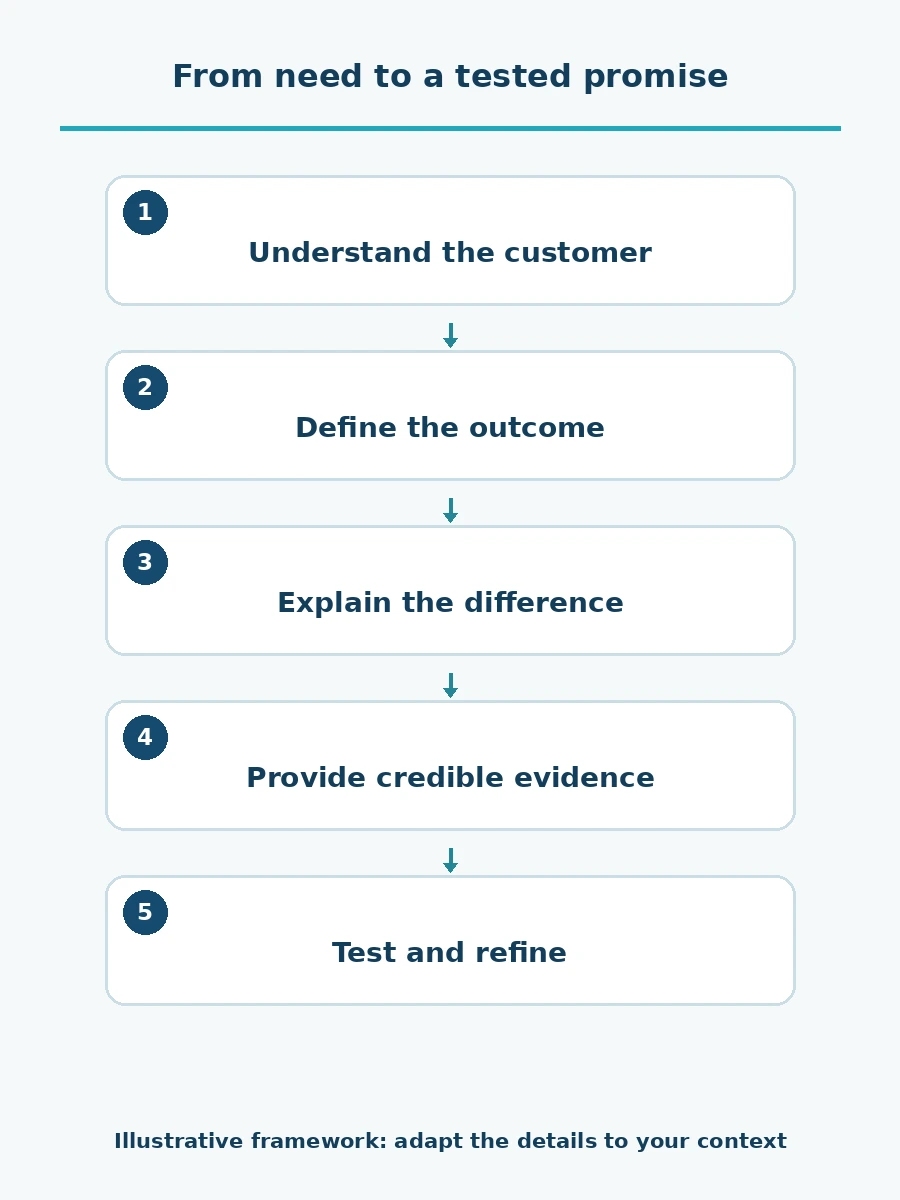
Start by naming the customer group and the situation in which the need appears, then describe the problem in their own words. Move to the outcome the offer is intended to support and explain how the delivery method helps achieve it. For example, go beyond promising “better follow-up”: explain that each request will appear in a shared queue with a named owner and an updated status.
Once the promise is understandable, add appropriate evidence and its limits, and review it with operations. If the team cannot perform a step the promise depends on, revise the offer or establish the required capability before publishing it. This connects the message to what the customer will actually receive.
This sequence is a drafting aid, not a formula that guarantees conversion. You may need a short headline and a supporting paragraph rather than one sentence containing everything. Clarity matters more than forcing the statement into a fashionable template.
Test understanding separately from willingness to buy
First, ask representative customers to explain what they think the offer means. Can they identify who it is for, what it does and why it may matter? Revise ambiguous wording before testing commercial response. Otherwise, a weak result may reflect confusion rather than lack of demand.
Then examine behaviour appropriate to the offer, such as a qualified enquiry, a requested demonstration or a limited paid trial. Define what counts as a meaningful response before the test. A click is not the same as a purchase, and a purchase does not by itself prove that customers will remain satisfied.
Imagine an illustrative test of 2 messages with comparable groups of 100 qualified customers each. The first message produces 20 clicks and 2 paid trials; the second produces 12 clicks and 4 paid trials. Paid-trial conversion among all customers shown the offer is 2% for the first and 4% for the second. Looking only at clicks would favour the first, although the second produced a higher commercial response in this sample.
These small counts do not establish a reliable winner. When testing wording, assign participants randomly where practical and keep price, scope, communication method and timing consistent. Changing these alongside the message prevents attributing the difference to wording alone. Define the decision criterion and duration before testing, and record payments, cancellations and delivery quality. Marketing reviews the results with sales and operations to decide whether to extend the test or revise the offer; a limited test result must not become a general promise to customers.
Keep the promise consistent across the experience
Your website, proposal, sales conversation and delivery team should describe the same scope. Record exclusions and conditions that materially affect the customer’s decision. If a service depends on information the customer must supply, make that dependency clear before work begins.
When the offer changes, review the wording and supporting evidence together. Do not leave an old guarantee or outdated case example on a landing page after the delivery model has changed. Assign a content owner who can check claims with the people responsible for operations.
Common questions
Must the offer be completely unique?
No. A useful proposition can explain a relevant combination of scope, delivery method and support. Avoid claiming exclusivity unless it can be verified. The customer needs a reason to choose, not an unsupported claim that no alternative exists.
Should every customer see the same statement?
A consistent core offer can have different explanations for different audiences. Keep the underlying facts and commitments aligned. If the actual offer differs, document that difference instead of changing only the marketing language. Preserve the same meaning in Arabic and English.
Review the evidence when the promise changes
For each important claim, retain its source, date, scope and the operations owner who confirms it. If the service or delivery conditions change, check whether the evidence remains valid before reusing the wording in a new campaign. The general description may still be accurate while support or delivery details have become outdated. Record the approved wording and update its uses together so customers receive consistent promises from the website, proposal and sales team.
Develop the offer with ATMACSS
Bring your customer evidence, current offer and the main objections you hear. Discuss Business Development with ATMACSS to connect the proposition with a practical commercial approach. The business modelling article explains how the promise connects to delivery and economics.