



A business portfolio presents selected work and capabilities to help a prospective customer assess suitability. It should explain what was done, by whom and with what evidence. This article focuses on a client-facing company portfolio, rather than an investment portfolio. It shows how to choose examples, organize the story and protect accuracy when presenting projects, people and results.
Start with the reader's decision
Identify who will read the portfolio and what they need to decide. A procurement reviewer may need evidence of relevant experience. A technical manager may want to understand delivery methods. An executive may need a short explanation of the problem addressed and the outcome. One document can support these readers through a clear hierarchy.
Write a purpose statement before choosing pages or images. For example, a fictional service provider might prepare a portfolio to demonstrate its ability to document operational processes. That purpose would favor examples of analysis and usable outputs, rather than unrelated photographs or a long list of every service offered.
Do not confuse a company profile with a portfolio. A profile explains who the organization is and what it offers. A portfolio demonstrates selected capability through evidence. The two can sit together, but a list of services does not become proof of experience simply because it is attractively designed.
Select work that matches the purpose
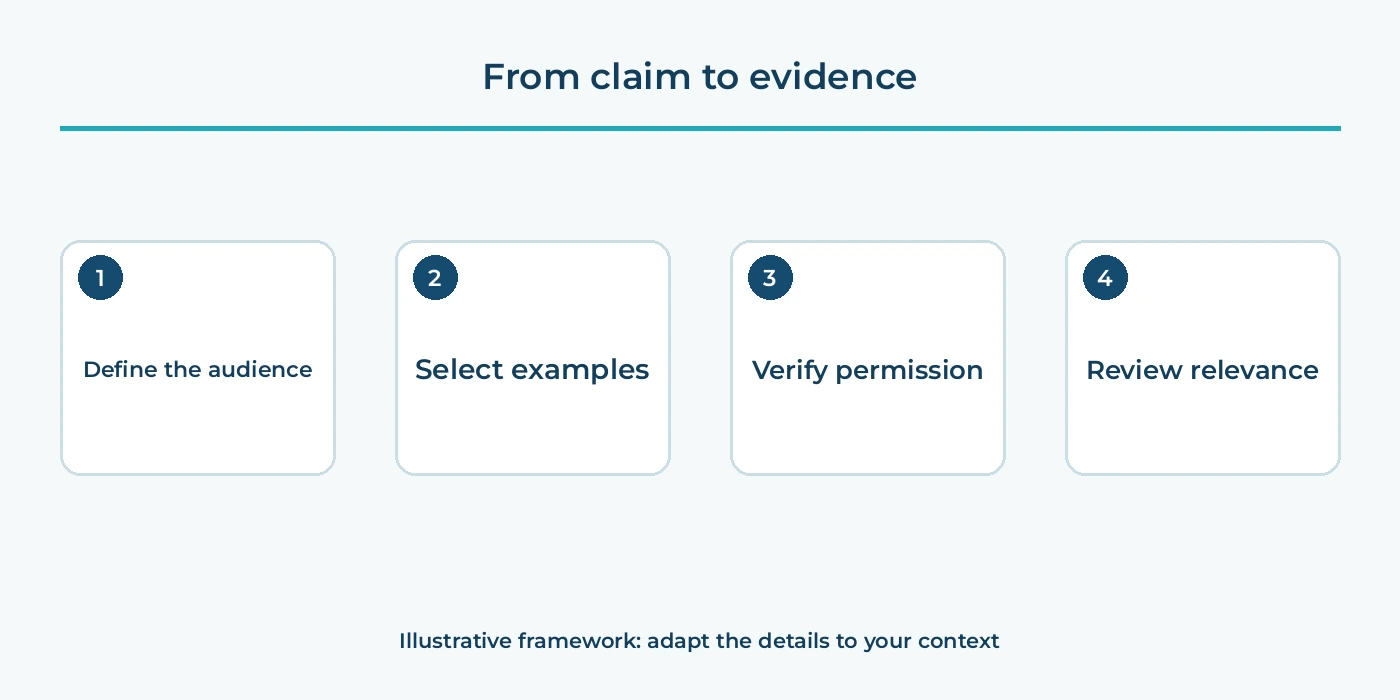
Choose examples for relevance, evidence quality and permission to disclose. A smaller, well-documented assignment may be more useful than a famous client name with no explanation. Ask what each example demonstrates and whether the reader can understand the contribution without confidential background information.
For every candidate, record the client or context, date, scope, role, outputs and available evidence. Distinguish work contracted by the company from experience gained by individual experts elsewhere. Do not imply that a recently established company delivered every project in its experts' careers.
If disclosure permission is missing, seek an authorized alternative. An anonymized example may be suitable when confidentiality is preserved and the underlying facts are supportable. Removing a name alone may not prevent identification. Review contextual details, images and combinations of information before publishing.
If a new company has no previous work it can publish, it can prepare a demonstration using synthetic data. Label it clearly as an illustrative sample not delivered for a client, and explain the skill it demonstrates. This can show thinking and output quality; it does not prove client delivery experience or commercial results. Do not add a client name or testimonial suggesting otherwise.
Build a case that can be checked
Use a repeatable evidence structure without forcing every case into identical wording. Describe the initial situation, agreed scope, specific contribution, outputs and observed result. State the period and measurement basis when reporting a change. Distinguish a delivered document from an operational improvement.
| Case element | Useful content | Weak substitute |
|---|---|---|
| Situation | The actual problem and context | A general statement about competition |
| Contribution | Work performed within a stated role | “We transformed the business” |
| Output | An approved process map or other deliverable | An unexplained photograph |
| Result | A supported observation with limits | An unverified percentage improvement |
Consider a hypothetical process-documentation assignment. Approved procedures show that documentation was delivered. They do not prove that processing time fell. A time-reduction claim needs comparable measurements and an explanation of other changes that could have influenced the result. If that evidence is unavailable, describe the documented output accurately.
A hypothetical case might read: “Over 6 weeks, our team documented order processing in one department. Our role included interviews with process owners, a process map and 3 procedures. The department owner approved the final versions. The assignment covered documentation and handover; it did not include measuring implementation effects.” In a comparable real case, the approval record and approved versions could support the delivery statement, subject to disclosure permission. This is a teaching example, not an ATMACSS project. It would not justify adding “we improved efficiency by 30%” without supporting measurement.
Explain the people and responsibilities
Present expertise in a way that matches the actual working arrangement. An external specialist should not appear as a permanent employee unless that is true. Clarify the role people would perform and the basis of any claimed qualifications. Avoid implying that everyone pictured is available for every assignment.
When an expert's previous experience is relevant, attribute it clearly to that person. Explain the role and contribution rather than borrowing the reputation of the organization involved. This helps the reader assess capability while preserving the distinction between individual experience and company delivery history.
Maintain an internal evidence record for qualifications, project statements and client permissions. The public portfolio can remain concise. Its supporting records should allow an authorized reviewer to trace each material claim without depending on the memory of its original author.
Design for scanning and deeper review
Place the main capability and relevant examples near the beginning. Use descriptive headings, short introductions and readable captions. Let a reader understand each page's purpose without interpreting decorative symbols. Keep detailed evidence available through a clear appendix or a working link where disclosure is permitted.
Use images that explain the work. A process diagram can show the scope of an assignment; a generic meeting photograph cannot demonstrate its results. Label illustrative material honestly. Check the document on a phone as well as a large screen, and ensure exported text remains readable.
Organize examples by the customer's problem or the capability being demonstrated. Chronology may be useful, but it should not bury the most relevant evidence. Avoid repeating the same case in several sections merely to make the portfolio seem larger.
Review claims and keep versions controlled
Before sharing, check names, dates, numbers, permissions, links and image rights. Confirm that every result is still described accurately. Remove unsupported superlatives and guarantees. A review should also identify expired qualifications, changed services or people whose current involvement differs from the description.
Make publication permission specific: which text or image is approved, whether the client’s name and logo are included, where it may appear, and who approved it. Do not assume permission to name a client also covers project details or a quotation. Inspect the exported file itself for internal comments and information that should have been removed. These are practical review controls, applied alongside the actual agreement.
Assign an owner and a review date. Keep a master version and identify which version was shared with a particular prospect. When a claim changes, update all public locations that use it. Otherwise, an old downloadable file can contradict a corrected website page.
Test whether the portfolio helps selection
Ask a colleague unfamiliar with the work to explain what the company can do and which evidence supports that conclusion. Note where they confuse company experience with individual experience or outputs with outcomes. Improve those sections before adding more pages.
Connect the portfolio to a clear next step, such as discussing the prospect's requirements. The value proposition article helps connect the evidence with customer needs. Business development support can help structure the wider opportunity. Begin with one relevant case, verify its claims and permissions, then build the rest of the portfolio around the same evidence discipline.