



Cybersecurity protects the information, systems and digital services that support business operations. For an organization in the UAE, a useful starting point is to connect security decisions with the work that must continue, the data that needs protection and the people authorized to act. This article presents a management workflow, with an illustrative business scenario, rather than a technical configuration guide or a legal compliance assessment.
Start with the business service
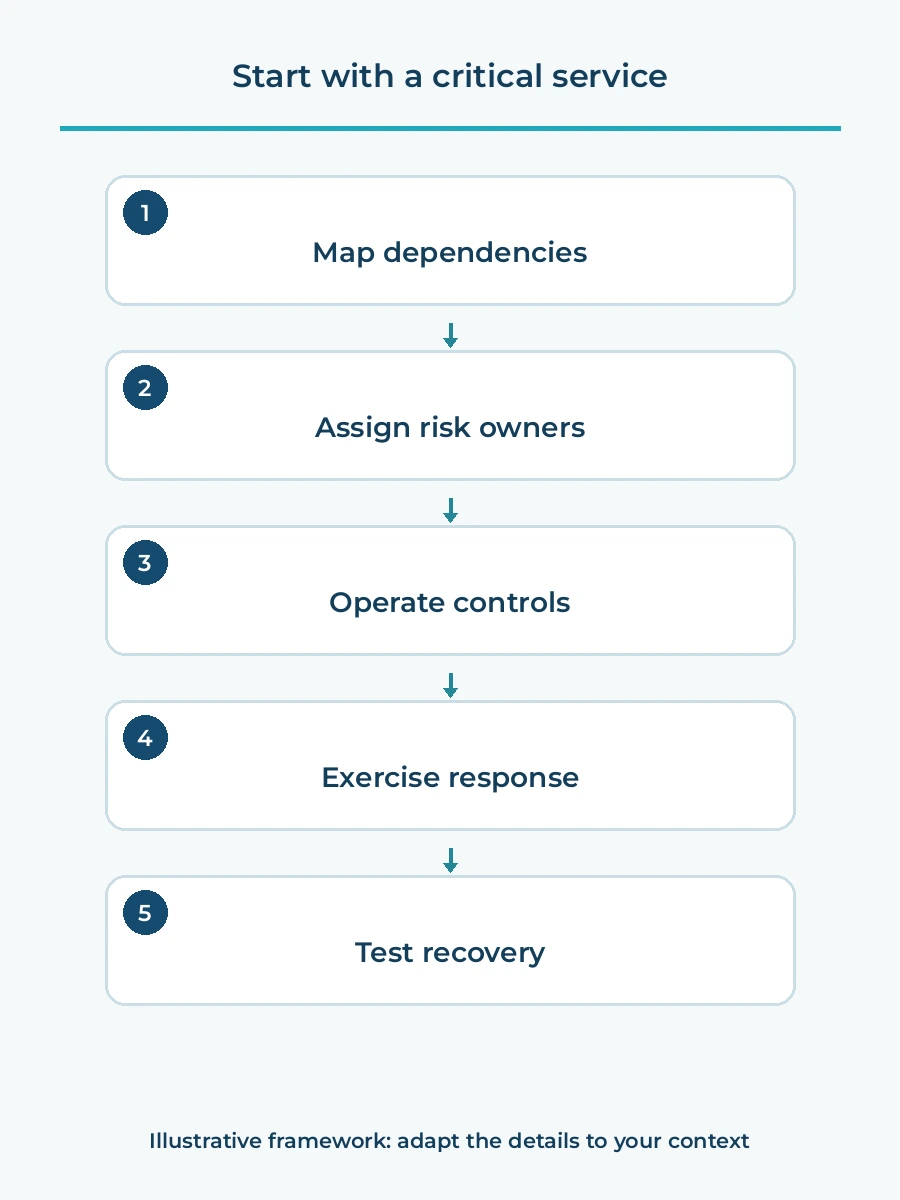
Choose a service whose interruption would matter to customers or staff. Map the information, applications, devices, suppliers and people needed to deliver it. The aim is to understand a dependency, not to produce a long inventory that nobody maintains. Assign an owner who can explain the operational consequence of losing that service.
Consider a fictional distributor that receives orders by email, records them in a cloud application and shares delivery instructions with a logistics provider. Its security discussion should include the email account, order records, integration permissions and supplier handover. Looking only at office laptops would miss important parts of the service.
Ask what would happen if information became unavailable, was changed without authorization or reached the wrong person. These are different problems and may require different controls. Record the consequence in operational terms, such as delayed dispatch or incorrect delivery instructions, rather than describing every risk as simply “high.”
Establish responsibility before buying tools
The NIST Cybersecurity Framework 2.0 organizes outcomes under six functions: Govern, Identify, Protect, Detect, Respond and Recover. It provides a useful structure for discussing responsibility across the organization. It is not a universal product checklist, a substitute for applicable obligations or proof that an organization is secure.
Name the person who accepts a risk, the person who operates the control and the person who checks whether it works. In a small business, one person may hold several roles, but the decisions should still be explicit. An external provider can perform work without removing management's responsibility to understand the agreed scope.
For the distributor, the operations manager can define the acceptable disruption to dispatch, while the technology provider explains available recovery options. Management then approves the approach and resources. A purchase order for a security tool does not, by itself, settle those decisions or establish who will respond outside normal hours.
Make account access reviewable
Use individual accounts where practical so that permissions and actions can be associated with the right person. Define access according to the work someone needs to perform. Review changes when employees join, move roles or leave, and include temporary staff and supplier accounts in the same process.
Strong, unique passwords and multifactor authentication can help protect accounts. Follow the current guidance of the service provider and relevant security authorities when choosing and configuring methods. Record exceptions and assign an owner to resolve them rather than silently treating an unprotected account as an unavoidable permanent condition.
In the distributor example, the person who prepares an order may not need authority to change payment details or administer all users. Review a small sample of actual permissions against approved roles. This practical check can reveal whether the access policy is reflected in the system, without assuming that a written policy proves implementation.
Keep maintenance and reporting visible
Assign responsibility for software updates, supported versions and devices that need special handling. The responsible technical team should assess deployment and compatibility requirements. Management needs a clear view of overdue work and accepted exceptions, not a vague statement that “updates are handled automatically” when important systems are excluded.
Teach staff how to report suspicious messages or unexpected account activity through a known channel. The NIST small-business guide addresses staff awareness and reporting; the organization's procedure should explain where that report goes and who responds. Encourage early reporting instead of creating a culture in which staff hide an accidental click.
For the distributor, a message requesting a change to a supplier's payment instructions deserves an established verification route. Staff should know the approved process and authorized contact, rather than improvising under pressure. Verify through a previously known contact and a channel independent of the message, rather than relying solely on a number or link supplied in it. This is an operational control example, not a claim that every suspicious message has the same technical cause.
Prepare a response that people can use
Write a concise response plan with named roles, escalation contacts and decision authority. Include how the team communicates if its usual email or collaboration system is unavailable. Keep access to essential contact information consistent with the plan, while protecting sensitive details from unnecessary distribution.
Use a discussion exercise before relying on the plan. Present a fictional situation: the order application becomes unavailable and unusual account activity is reported. Ask who assesses the situation, who can authorize operational changes and who communicates with staff and customers. Record uncertainties rather than treating quick answers as evidence of readiness.
The exercise should not require staff to investigate beyond their competence or make changes that could destroy useful evidence. Technical containment and recovery decisions belong to the authorized response team. Management should ensure the team can obtain appropriate expertise and record decisions as the situation develops.
Test recovery against operational needs
A backup record is not the same as a demonstrated ability to resume work. Plan authorized recovery tests with the technical owner and inspect whether the restored information is usable. Agree what evidence is needed and how the exercise avoids disrupting normal operations or exposing sensitive data.
In the distributor example, restoring a file is only part of the test. Staff also need to know which orders were already dispatched, which instructions were sent and how duplicated processing will be prevented. The operational owner should participate because a technically successful restoration may still leave an unresolved business problem.
Illustrative example: management approves resuming order processing within 4 hours of service interruption, with record integrity checked and duplicate dispatch prevented. This is an internal target for the example, not a mandatory limit or general benchmark. An authorized test restores the application within 3 hours, but reconciling orders and verifying instructions takes another 3 hours. Operations are therefore ready after 6 hours, exceeding the target by 2 hours. Application availability alone is insufficient to declare recovery successful.
The operations owner records the cause and impact of the delay and agrees a corrective action and due date with the technical owner. The action might improve the dispatched-order record or clarify reconciliation ownership. Retest the scenario against the same acceptance criteria. Updating the document alone does not close the action: retain evidence that the team could resume accurate operations within the approved target, or a documented management decision on how to address the remaining gap. Check the freshness of restored data as well; quickly restoring outdated records does not establish that the required service has recovered.
| Review area | Management question | Evidence to inspect |
|---|---|---|
| Access | Are permissions appropriate? | Approved roles and a checked sample |
| Maintenance | Who owns exceptions? | Current exception and action record |
| Response | Can people reach the decision maker? | Exercise findings and corrected contacts |
| Recovery | Can the service resume accurately? | Test result and operational reconciliation |
Review suppliers, obligations and progress
Clarify what a supplier protects, what remains your responsibility and how incidents or service interruptions are communicated. Confirm the process for obtaining data and ending the relationship. Contract language, service design and operational practice should tell a consistent story; assumptions between the parties are a common source of unresolved work.
For UAE operations, identify the legal, regulatory and contractual requirements that apply to the particular entity, sector, data and activity. Have the appropriate adviser verify applicability and current requirements. This article does not prescribe a universal reporting deadline or claim that one framework satisfies every UAE obligation.
Review progress through owned actions: the weakness, its business effect, the agreed response, the responsible person and the evidence of completion. The IT management article provides related context. Begin with one critical service and a tested improvement, then extend the approach as the organization learns where its real dependencies and control gaps lie.
Risk management support can help connect cybersecurity actions with wider business risk ownership.