



A business can have strong demand and still struggle to grow. The constraint may be conversion, delivery capacity, cash timing or a dependency that the team has not identified. This article explains how to locate the current constraint before buying technology, increasing promotion or entering another market, using a fictional service business to make the reasoning concrete.
Define the constraint you are investigating
A growth constraint is a condition that currently limits the organisation’s ability to generate and fulfil worthwhile additional business. It is not simply anything that could be improved. A slow internal task matters differently depending on whether it actually restricts customer commitments, quality or cash.
A bottleneck is a step whose capacity limits the flow of work through the process. Suppose preparation can handle 10 files daily, but a specialist can approve only 6. Files may accumulate before approval. This is a hypothetical illustration, assuming every file needs the same approval. A growth constraint is broader: weak demand or insufficient cash can limit growth without a queue at an operating step.
Start with a specific question: what prevents the next suitable order from being completed at the intended quality and economics? This keeps the review focused. A long wish list of systems, people and marketing activities can obscure the dependency that needs attention first.
Follow demand through to cash
Business starts with a suitable customer’s interest, then moves to an accepted order, delivery and payment. Conversion here means moving a suitable opportunity into an accepted order. Operational capacity is the work that can be completed at the required quality within a defined period. Use the table to locate loss or delay across the process.
| Stage | Evidence to examine |
|---|---|
| Demand | Suitable enquiries and reasons for poor fit |
| Conversion | Decisions, lost opportunities and sales-cycle time |
| Delivery | Capacity, waiting work, rework and completion dates |
| Cash | Collection dates, amounts owed by customers and payments due |
Keep definitions consistent and follow the same type of work across stages. An enquiry is not an order, and an invoice is not cash received. If the data cannot be connected, start with a small set of recent jobs and reconstruct the actual sequence from reliable records.
Reconcile the movement of waiting work
The backlog is accepted work that has not yet been completed. Start with unfinished work at the beginning of the period, add accepted orders and subtract completed and cancelled work using clear definitions. If the calculated balance differs from the team’s records, check duplicates, reopened jobs and transfers between departments. Do not substitute enquiry counts for accepted orders in this reconciliation.
Measure the age of waiting work as well as its volume. The count can remain stable while complex jobs repeatedly wait because easier work is completed first. Record job type, commitment date and reason for waiting. Then check whether the intervention improved customer delivery or moved the delay elsewhere. This helps distinguish a temporary increase in workload from a persistent constraint requiring an operating decision. Accumulating work is a signal to investigate, not proof of its cause. Examine waiting time and actual processing time. Check missing information or unavailable resources before attributing the problem to a slow employee.
Counts must cover the same type of work and reporting period. If complex jobs take much longer, adding them to simple jobs can conceal the workload. Separate job types or compare required work hours with available capacity. Measure an order’s age from acceptance, and track its agreed delivery date separately.
Check whether additional work is worthwhile
Compare the expected revenue from additional work with the extra costs needed to deliver it. Examine what the business earns and what it must spend because of that work. Consider discounts, fulfilment effort, rework and customer support. Revenue growth can look attractive while consuming more resources than expected. Avoid assuming that every extra order produces the same margin as the average historical order.
Include new costs triggered by expansion, such as another salary or a software subscription. Revenue less the costs associated with a particular order is not the whole business’s net profit. Other expenses still matter when assessing expansion.
Then examine cash timing. A profitable contract may require expenditure before payment arrives. Profit and available cash are different. Prepare a realistic schedule of receipts and commitments using the contract and operating plan. Seek appropriate financial advice for funding decisions; the diagnostic workflow here is not a recommendation for a particular loan or investment.
Hypothetical example: more orders, unchanged delivery
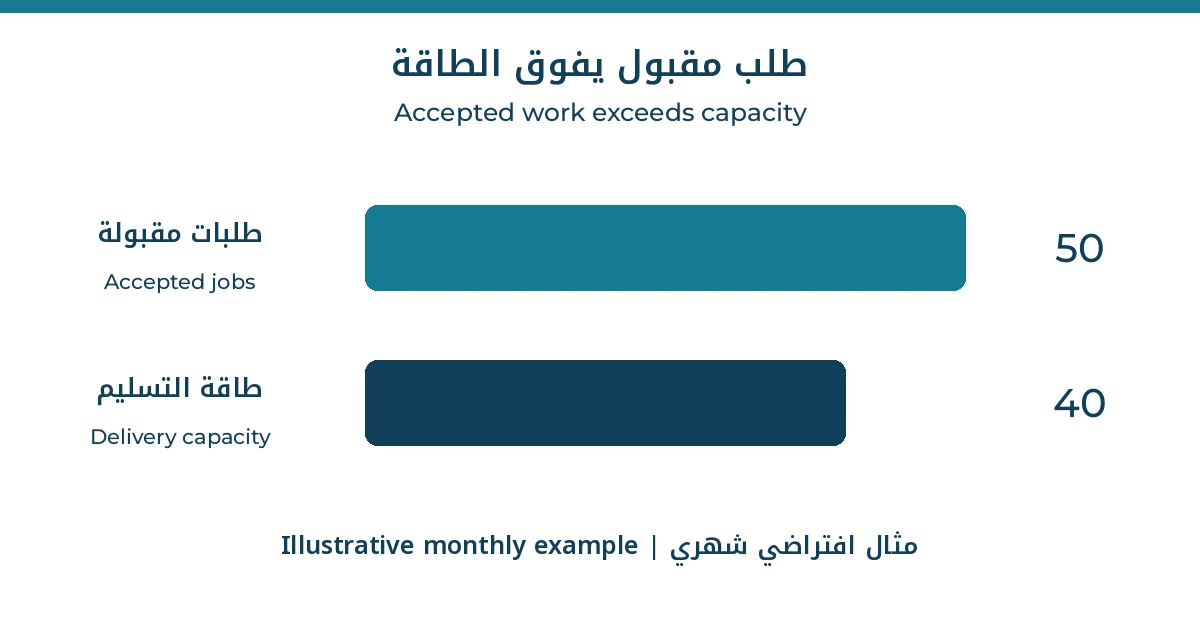
A fictional service business starts the month with 20 unfinished jobs. It accepts 50 new jobs and completes 40, with no cancellations. Its closing backlog is 30 jobs: 20 + 50 − 40 = 30. Assume similar effort per job and actual completions equal to available capacity. These teaching figures are not operating benchmarks.
In the next month, a campaign raises accepted orders to 60 while completions remain 40, with no cancellations. The backlog moves from 30 to 50 jobs: 30 + 60 − 40 = 50. Waiting work increases by 20 jobs that month, compared with the previous increase of 10. More enquiries alone do not establish this increase; the calculation uses accepted orders.
The team examines the delivery process and finds that a specialist approval is required for every job. The specialist spends time correcting incomplete submissions. Before recruiting another salesperson, the company tests a clearer submission check and reviews which approvals genuinely require specialist judgement.
If the change releases capacity, verify that quality and staff workload remain acceptable. The constraint may then move to delivery staff availability or another stage. Improving one step does not establish unlimited capacity for the whole business or justify commitments beyond the tested capacity.
Choose an intervention that addresses the cause
Identify the likely cause before choosing a solution. A customer may hesitate because the offer is unclear. An accepted order may wait because its file is incomplete or a specialist is unavailable. Each case needs a different intervention. The options below guide investigation; establish the cause through records and discussion with the responsible people.
- Demand constraint
- Test the audience, offer and route to suitable customers.
- Conversion constraint
- Review fit, evidence, pricing and the decision process.
- Delivery constraint
- Examine the limiting step, handovers and rework.
- Cash constraint
- Review commitments, billing, collection and approved financing options.
Technology, sustainability initiatives and geographic expansion can all be relevant, but none is an automatic answer. State the mechanism by which the proposed change would relieve the observed constraint. If that explanation is missing, the investment case is not yet ready.
Test at a manageable scale
Choose a bounded change with an owner and an observation period suited to the work cycle. Establish the starting position and record other changes happening at the same time. Compare completed work, service quality, resource use and cash effects rather than measuring activity alone.
Stop or modify the test if it creates an unacceptable effect elsewhere. Faster acceptance can overload delivery; faster delivery can increase rework if checks are removed. The aim is better end-to-end performance, not making one team’s measure look better at another team’s expense.
In the file example, the delivery owner defines a complete submission and tests the check on a specific job type. Compare completeness on receipt, specialist waiting time and completed work. A better initial check is insufficient if delivery does not improve. Set acceptable quality and staff workload limits before testing. Review the result with sales, delivery and finance owners.
Record the test in a short log covering the change, owner, application period, baseline, results and limits of interpretation. State the next decision: adopt, modify or stop the change. Higher completions are insufficient if errors or overtime rise to an unacceptable level. If the evidence is insufficient, collect more before increasing commitments.
Use the evidence to decide the next investment
At review, distinguish a demonstrated result from a plausible explanation and an untested assumption. Keep uncertainty visible. A short test in a quiet month may not support the same conclusion during a seasonal peak or after a major change in customer mix.
Start by tracing 5 recent suitable opportunities from enquiry to completion and payment. Include lost and pending opportunities, recording the last stage each reached. Do not assume they all ended in completion and payment. This is an initial diagnostic sample, not a statistically representative study. Identify the recurring delay or loss and investigate it before committing to expansion.
Connect the findings to your growth strategy and business development plan.
NIST guidance emphasises priorities, resources and progress monitoring. SBA guidance explains the importance of tracking revenue, expenses and available cash. This diagnostic workflow and example are an editorial application, not an official model issued by either organisation. If coordination across departments is needed, consider the scope of business development support against the constraint established by the review.
Trace actual work, locate the delay or loss, and examine the economics and cash timing of additional orders. Then test a change that addresses the cause and check its effect across the process. Expand investment when the results support that decision. Reassess when demand changes or the constraint moves elsewhere.