


ISO 55001:2024 specifies requirements for an asset management system. It helps organisations connect decisions about assets with the value they need to deliver across the asset life cycle. The practical issue is broader than maintenance: acquisition, use, renewal and disposal all affect performance, expenditure and risk. A useful system makes those choices more consistent and traceable.
What the current edition covers
ISO lists ISO 55001:2024 as the second edition, published in July 2024, replacing the 2014 edition. It addresses the management system through which an organisation establishes and improves its approach to assets. It should not be confused with a product specification or a guarantee that an individual asset will never fail.
ISO 55000 provides related overview and terminology, while ISO 55001 sets system requirements. This article is an implementation-oriented introduction, not a reproduction of the standard or a substitute for its full requirements. Use the current official text when defining or assessing conformity.
Begin with the service the assets support
Ask what the organisation needs its assets to enable. A pump, vehicle or building matters because of its contribution to an objective or service. This perspective helps teams discuss priorities across engineering, operations, finance and leadership instead of treating the asset register as a separate administrative exercise.
Define the scope of the proposed system and the relevant asset portfolio. Explain boundaries and dependencies, including externally provided activities. A narrow pilot may be useful for learning, but its limits should be clear so that conclusions are not presented as applying to the entire organisation.
Build information that supports decisions
Start with the information needed for a practical decision. For a physical asset, this may include identification, location, function, condition, maintenance history, criticality and ownership of the record. The appropriate fields depend on the asset and the decision; collecting every available field is not automatically better.
Check the quality of the information. Duplicate records, inconsistent identifiers and missing histories can make a sophisticated system unreliable. Assign responsibility for updates and define how changes enter the record. A one-time data-cleaning exercise will not remain useful if daily processes recreate the same errors.
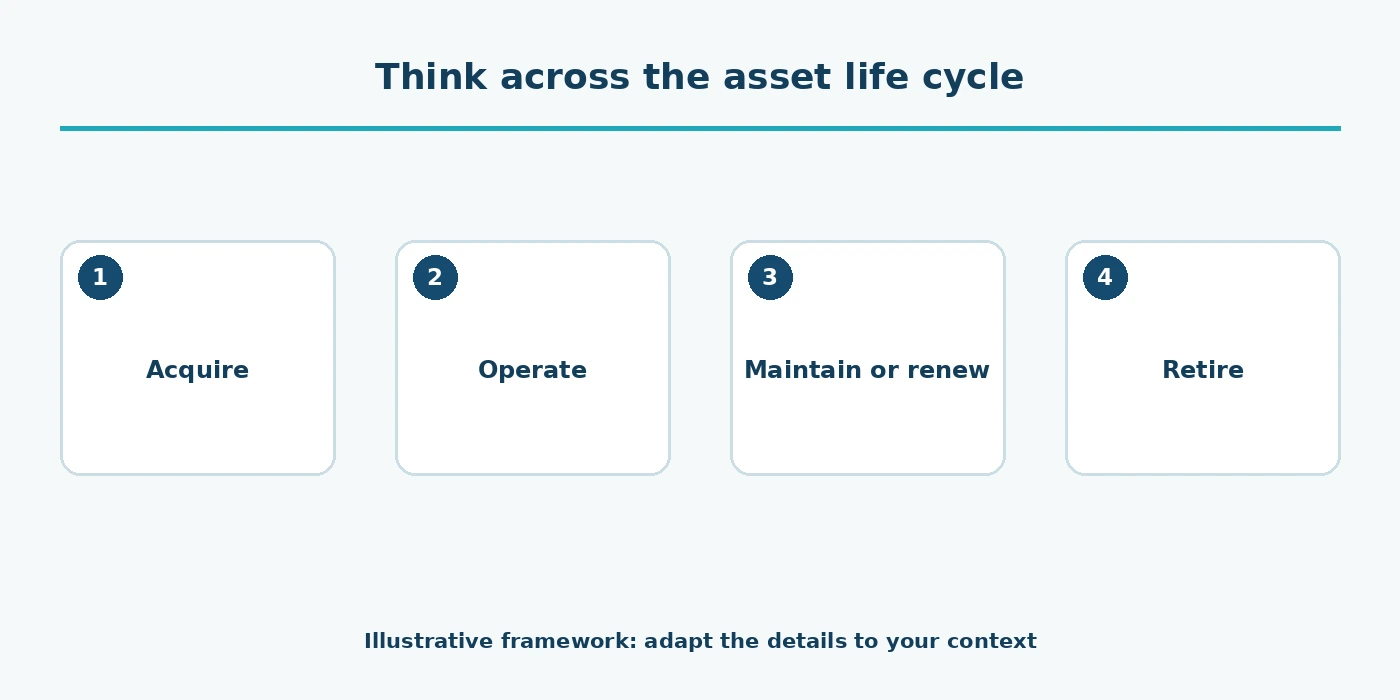
Compare options across the life cycle
Purchase price is only one part of an asset decision. Consider installation, operation, maintenance, interruption, renewal and end-of-life arrangements where relevant. State assumptions about demand, useful service and costs, and examine how a different assumption would affect the choice.
| Decision stage | Practical question | Information to examine |
|---|---|---|
| Acquire | Which option meets the required service? | Capability, total cost assumptions and constraints |
| Operate | Is the asset delivering the intended function? | Performance, condition and operating context |
| Maintain or renew | Which response is appropriate now? | Failure history, criticality and available alternatives |
| Retire | How will service and responsibilities be transferred? | Replacement readiness and disposal arrangements |
These questions illustrate life-cycle thinking; they are not a complete clause-by-clause conformity checklist. The purpose is to connect technical and commercial decisions so that a low initial cost does not conceal an unsuitable long-term commitment.
Use criticality to focus attention
Assets do not all have the same consequences of failure. Consider their role in service delivery, safety and other relevant objectives, together with dependencies and alternatives. A relatively inexpensive component can be important if its failure interrupts a critical process and no substitute is available.
Document the reasoning behind priorities. Do not rely only on age or replacement value. Review the assessment when the operating context changes, such as a higher workload or a new dependency. Where specialist engineering or safety judgement is needed, involve competent people rather than forcing the decision into a generic score.
A practical renewal example
Imagine a fictional facility deciding whether to repair or replace a pump. The team compares repair history, required service, expected downtime, spare availability and the readiness of a replacement option. It also considers whether the operating conditions contributed to the problem and would affect a new pump in the same way.
Compare both options over the same required service period and duty conditions. If a repair is expected to last for less than that period, include the subsequent intervention rather than comparing one repair invoice with the full cost of a new pump. State assumptions about energy use, maintenance, downtime and residual value, and avoid counting the same loss twice. Engineering and finance should examine how uncertain service life or demand could change the decision; mandatory safety and service constraints should not disappear inside a cost total.
If replacement is selected, define acceptance criteria before purchase and agree who will verify them. Plan the changeover, temporary service arrangements, operating instructions, spare parts and training. Release the replacement for use only after the appropriate checks and authorisation, and record unresolved issues. Update the asset register and maintenance plan, then arrange controlled retirement of the old asset once continuity and disposal responsibilities are addressed.
The preferred option depends on evidence and assumptions, not simply on whether repair is cheaper today. Record the decision, owner and conditions that trigger review. This example is illustrative, not an engineering recommendation, a prescribed ISO solution or an ATMACSS client case.
Connect roles, plans and review
Clarify who owns asset information, approves investment, plans maintenance and accepts operational changes. Different teams may hold different parts of the evidence. An effective review brings those perspectives together and makes unresolved trade-offs visible to the appropriate decision-maker.
Choose indicators linked to the objectives. These may cover service availability, overdue critical work or data quality, depending on the context. Explain definitions and review periods, and investigate trends rather than relying on a single dashboard colour. Use incidents and completed work to improve the underlying plans.
Understand certification correctly
An organisation may seek certification of its asset management system against ISO 55001 through an appropriate independent certification body. ISO itself does not issue certificates. Consultancy, internal review and third-party certification are distinct activities, and the scope of any certificate matters.
Certification does not guarantee a specific percentage reduction in cost or downtime. Before commissioning a project, agree the intended scope, current gaps, responsibilities and evidence required. Ask the relevant certification body about applicable transition arrangements if an existing certificate refers to an earlier edition; do not assume one deadline applies to every situation.
Prepare an implementation discussion with ATMACSS
Bring your asset scope, current registers, maintenance arrangements and recurring decision problems to a discussion about ISO Implementation & Certification support with ATMACSS. The ISO 31000 guide explains a complementary approach to uncertainty and risk. Begin with the decisions that need improvement, then connect the system requirements to real work and accountable owners.