



Choosing an ISO certification body means selecting an independent organization to assess conformity with a particular standard. The decision affects the credibility, scope and continuing cost of certification. This article explains what to verify before accepting a proposal, how to compare offers fairly and which warning signs deserve investigation. It also distinguishes implementation advice from independent certification.
Identify the certificate you actually need
Start with the requirement behind the purchase. A customer may request certification for a named legal entity, activity or site. Another organization may want an independent assessment to support its own management objectives. Read the actual requirement rather than relying on a general request for an “ISO certificate.”
Specify the standard, relevant edition, proposed scope and locations. Describe outsourced activities and important organizational boundaries. A certificate for one office should not be presented as covering every operation. Resolve unclear customer acceptance requirements before requesting quotations, because a low-cost offer has little value if it does not satisfy the intended need.
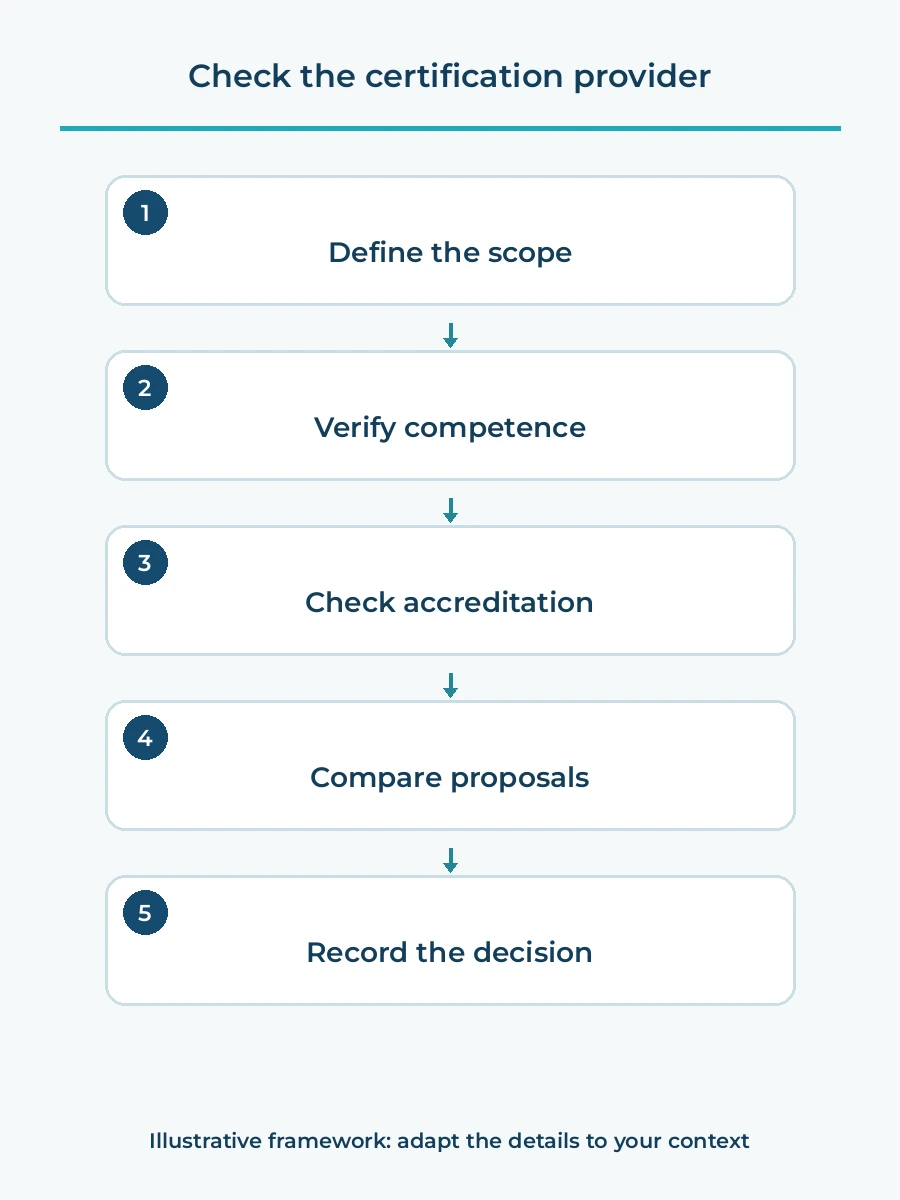
Keep three roles separate
ISO develops standards and does not issue organizational certificates. A certification body performs the relevant independent assessment. An accreditation body evaluates the competence of conformity assessment bodies for defined activities. These roles should not be presented as interchangeable.
ISO explains that accreditation is not compulsory in every situation. Lack of accreditation alone therefore does not prove fraud. However, customers or procurement rules may require accredited certification. Check the actual acceptance condition and verify the relevant accreditation scope through authoritative records.
ATMACSS provides implementation and certification-readiness support within an agreed scope. It does not issue ISO certificates or guarantee the decision of an independent certification body. Keep this distinction visible in procurement discussions, contracts and public statements.
Verify the organization behind the proposal
Request the legal name of the body that will issue the certificate. An intermediary's trading name may differ from the issuing entity. Ask who contracts with you, who performs the audit and who makes the certification decision. Unclear answers should be resolved before any commitment.
Where accredited certification is needed, verify that the issuing entity's accreditation covers the relevant standard and activity. Do not treat a logo in a brochure as sufficient evidence. Follow the accreditation body's own directory or contact channel, and keep the dated verification result with the selection record.
If certification is required for a tender or a particular customer, obtain written confirmation that the proposed issuing body, certificate scope and accreditation arrangements meet that request. Do not assume that “internationally recognized” settles acceptance in every market or contract. Keep this confirmation alongside accreditation verification; the two checks answer different questions.
Use certificate verification services identified by the relevant authorities when checking an existing certificate. Match the organization, scope, sites and current status. A missing database result warrants investigation; it is not, by itself, a complete finding that the certificate is false. Confirm the position with the appropriate issuing or accreditation body.
Compare proposals on the same basis
Prepare one request brief and send the same scope to each candidate. Include activities, sites, relevant staff arrangements, working patterns and the intended timetable. Explain material differences between sites. Ask candidates to state their assumptions so that you can identify where their proposals are not comparable.
| Comparison item | What to request | Why it matters |
|---|---|---|
| Scope | Entity, activities, sites and standard | Prevents purchasing the wrong coverage |
| Audit arrangements | Stages, methods and planned resources | Makes the assessment approach visible |
| Commercial terms | Included work, exclusions and additional charges | Supports a complete cost comparison |
| Continuing service | Follow-up arrangements and contact responsibilities | Clarifies obligations after the initial decision |
Do not create a score that hides a mandatory failure. If the required scope cannot be covered, that issue must remain visible regardless of price or customer service. Use preferences to compare acceptable options after checking essential conditions.
Examine competence and independence
Ask how the audit team understands your activities and associated risks. Relevant experience should concern the processes being assessed, not simply the number of years someone has worked. Confirm language arrangements and the information auditors will need to review.
The certification process should remain independent of implementation consulting. Ask the body to explain how it manages impartiality and complaints. A proposal promising a certificate in advance of assessment is a warning sign. Investigate any suggestion that buying a particular consulting service guarantees a favorable certification decision.
Discuss access and confidentiality before the audit. Identify records that contain sensitive information, suitable review arrangements and who authorizes access. Agree these arrangements without withholding evidence necessary for the assessment. Both excessive disclosure and incomplete evidence can create avoidable problems.
Calculate the continuing cost
Compare the expected assessment cycle, not only the initial invoice. Request the treatment of travel, additional sites, follow-up activity, rescheduling and changes in scope. Ask how future charges are calculated and when payment becomes due. Keep commercial assumptions separate from technical acceptance conditions.
Consider an illustrative comparison. One proposal includes travel while another excludes it. Their headline totals do not represent the same purchase. Create a cost schedule with consistent inclusions and mark uncertain items. Do not invent an estimate simply to make the table appear complete; request clarification instead.
Suppose two offers cover the same scope over an agreed comparison period of 3 years. Offer A charges AED 6,000 for the initial assessment, AED 2,000 for each of two follow-up visits, and AED 1,500 for travel over the whole period: AED 11,500 in total. Offer B charges AED 7,000 initially and AED 1,800 for each of two follow-up visits, including travel: AED 10,600 in total. B has the higher initial invoice but costs AED 900 less for these items.
These figures are hypothetical, not market prices or an audit schedule prescribed by a standard. The comparison assumes the same currency and coverage, and excludes taxes, recertification beyond the stated period and unplanned additional audits from both offers. Obtain prices or charging rules for excluded items before contracting. Scope, competence and acceptance conditions remain essential checks before comparing price.
Approve with a documented reason
Record the requirement, verified scope, comparison, unresolved issues and selection reason. Assign an owner for communication and continuing obligations. Before signing, check that the final contract reflects the proposal you evaluated. Material changes deserve another review, particularly when the issuing body or covered sites change.
After certification, retain the certificate and its verification information. Review the wording used on your website and proposals so that claims match the actual scope. Ask the issuing body about permitted use of its marks. A management-system certificate should not become an unsupported claim about every product or business outcome.
Distinguish the certification body’s mark from the ISO logo. Obtaining certification does not grant permission to use the ISO logo. Follow the issuing body’s rules for its own mark and certification statements. Assign someone to review those statements when scope changes or certification is suspended or expires, so outdated claims do not remain published.
For help preparing the underlying system, explore ISO implementation and certification readiness. The integrated management systems article explains how related management systems can work together. Begin your selection by writing a clear scope brief and a short list of evidence that each candidate must provide.