



Market research gathers and interprets information to support a business decision. It helps you understand customers, alternatives and the conditions in which an offer will compete. The useful starting point is a decision you need to make, such as which customer group to serve or which problem to investigate. Research reduces uncertainty; it does not remove commercial risk.
Write the decision before the questionnaire
A broad request to study the market often produces a large report with no clear consequence. Instead, write the decision, the alternatives and the information that could change your choice. If you are considering a new service, you may need to understand the current problem, purchasing responsibility and existing alternatives before estimating demand.
Define the geographical area, customer segment and time period. A finding from one emirate, sector or organisation size should not automatically be applied to another. Record the assumptions already being used so that research can challenge them rather than simply confirm the preferred proposal.
Combine existing information with direct research
Secondary research uses information already available, such as official statistics, industry publications and competitors’ public offers. Check the date, definitions, geographical coverage and method. Two reports may use the same market label while measuring different activities. A large headline number is not necessarily the market your business can realistically serve.
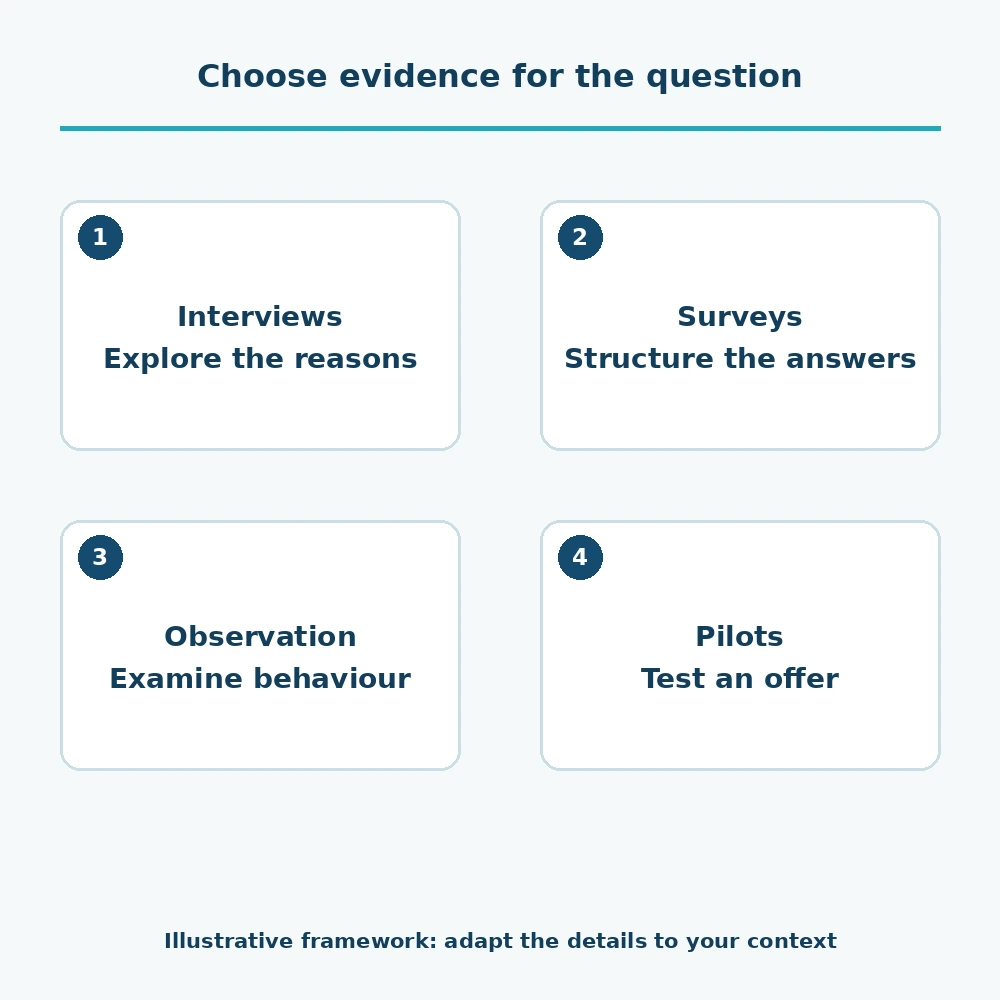
Primary research gathers information directly for your question. Interviews can explore how people describe a problem. Surveys can collect structured answers from a defined sample. Observation can show what happens in practice, while a limited pilot can test a specific offer. Choose methods for the evidence required, rather than choosing a survey because it is easy to distribute.
Match each question to a method
| Decision question | Possible method | What it cannot establish alone |
|---|---|---|
| Why do customers abandon a process? | Interviews and observation | The prevalence across all customers |
| How common is a stated preference? | A suitably designed survey | Actual purchasing behaviour |
| What alternatives are available? | Public information and customer interviews | Competitors’ confidential performance |
| Will customers accept this offer? | An honestly presented pilot | Long-term demand under every condition |
A mixed approach can be helpful when each method addresses a different uncertainty. Avoid collecting more data than the decision requires. A carefully designed small exploratory study can be useful, provided its limits are clear and it is not presented as statistically representative.
Recruit the right participants
Specify who qualifies for the research and how participants will be reached. Existing customers, lost customers and people who have never considered your offer may give different answers. Surveying only your social-media followers is a convenience sample, not a complete view of the market.
Record recruitment channels, eligibility rules, invitations and completed responses where relevant. Consider who is missing. Busy decision-makers, dissatisfied customers or people without access to a particular channel may be underrepresented. Do not use a large response count to conceal a biased selection process.
Ask neutral questions and pilot them
Ask about concrete experiences before asking people to predict future behaviour. “What happened the last time you purchased this service?” often reveals more than “Would you buy our excellent new solution?” Separate questions that address different ideas, and provide response options that do not force an inaccurate answer.
Test the questionnaire or interview guide with a small pilot. Check whether terms are understood consistently in Arabic and English. Translation should preserve the meaning of the question, not merely its wording. Explain the research purpose and handle participant information according to the applicable requirements and agreed arrangements.
A worked decision example
Imagine a fictional maintenance provider considering an evening service. Interviews reveal that some customers struggle to arrange daytime access, but others prefer daytime visits for security reasons. A survey could examine how these preferences vary among eligible customers. A limited pilot could then test booking, attendance and delivery costs.
The decision should connect these findings. A popular idea may still be difficult to deliver within the proposed price. Conversely, a smaller segment may have a clear need that the business can serve well. This example is an illustration, not an ATMACSS client case or a forecast of demand.
To see why the denominator matters, assume the survey is sent to 200 eligible customers and 50 complete it, with 30 supporting an evening service. Support among respondents is 30 ÷ 50 × 100 = 60%, while completed responses represent 25% of those invited. This does not mean that 60% of all customers want the service: the views of 150 nonrespondents remain unknown. Dividing supporters by invitations gives 15%, but it is not an alternative estimate of market preference, because that interpretation treats missing answers as a lack of support.
Record when and how invitations were sent and whether some groups responded less often, then investigate differences through appropriate, neutral follow-up. Before adding a permanent evening team, offer a limited number of appointments with a clear price and scope, and measure paid bookings, cancellations and delivery costs. Research, operations and finance agree continuation or revision criteria in advance. Survey support is not confirmed demand, and these figures are hypothetical rather than actual research findings.
Analyse differences, not just averages
Review results by meaningful groups only when the available data supports the comparison. Show the number of responses behind percentages and explain missing answers. Do not imply a conventional margin of error for a convenience sample as though respondents had been selected through a suitable probability design.
Look for disagreement between what people say and what they do. Treat that difference as a question to investigate. Keep direct findings, interpretations and recommendations separate. If the evidence is inconclusive, state what remains unknown and identify the next proportionate test instead of manufacturing certainty.
Turn the findings into a decision record
A useful report states the question, method, coverage, findings, limitations and recommended action. It explains why the evidence supports a choice and what would trigger reconsideration. Assign an owner and review date, especially when market conditions or customer behaviour may change.
ATMACSS’s Business Development service offers a starting point for discussing commercial questions and research needs. Bring your proposed offer, target segment and existing evidence. The value proposition guide explains how findings can become a clearer, testable customer promise.