



Business development skills help people identify, evaluate and advance opportunities for growth. They combine customer understanding, commercial judgment, communication and delivery coordination. This article explains how to assess those skills through observable work rather than confident presentations. It also shows how to build a focused development plan for someone responsible for new opportunities, partnerships or markets.
Define the job before listing skills
Business development can mean different work in different organizations. One role may investigate new markets; another may develop partnerships or qualify opportunities. Write the decisions and outputs the role must produce before selecting training or recruiting someone. Otherwise, a broad list of desirable qualities can hide an unclear job.
Separate opportunity development from closing a sale. The activities can overlap, but they are not identical. A promising partnership may need operational design before any revenue appears. Conversely, a salesperson may work with a defined offer and an established customer segment. Assess capability against the actual assignment.
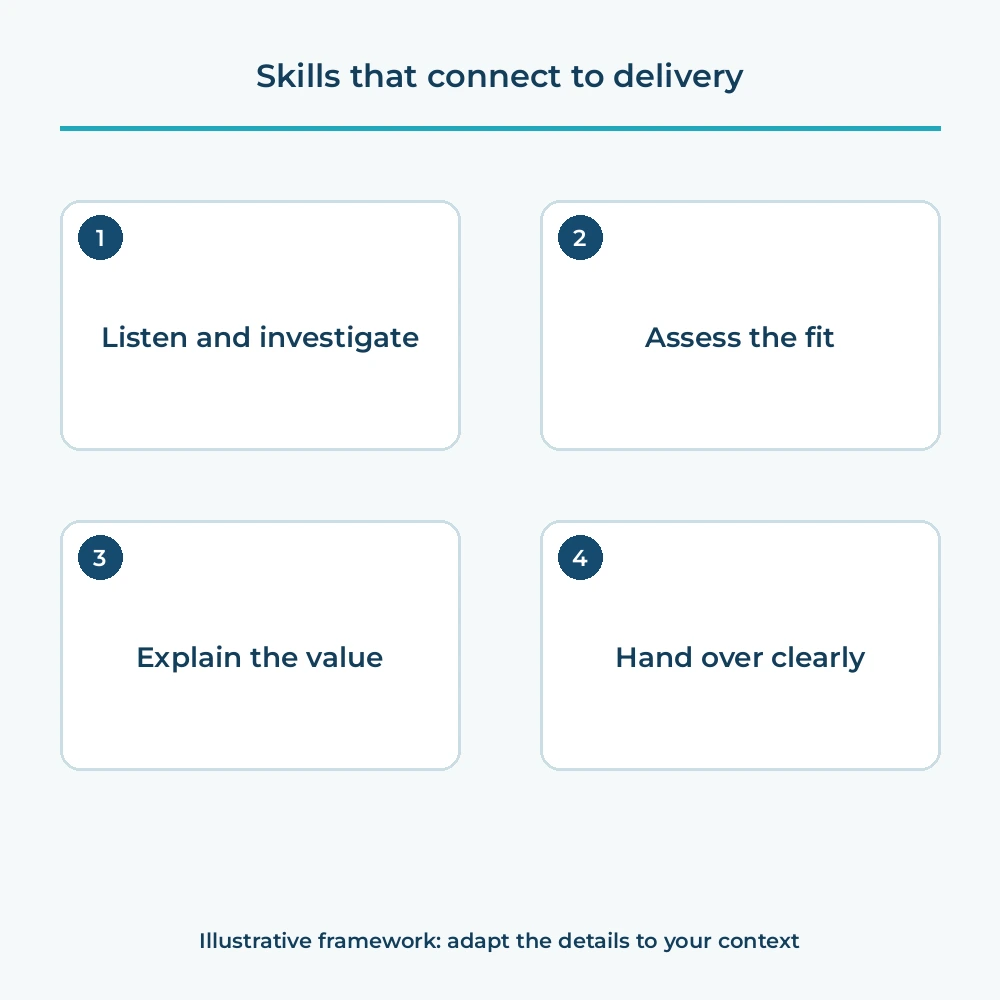
Investigate customer needs without leading the answer
A capable business developer asks about the customer's work, constraints and existing alternatives. They listen for evidence and distinguish a polite reaction from a commitment. Asking whether someone “likes our innovative solution” produces less useful information than asking how they currently solve the problem.
Use a work sample to assess this skill. Give the person a short fictional customer brief and ask them to prepare interview questions. Look for neutral wording, attention to decision makers and an interest in the cost of the current problem. During a practice interview, examine whether they follow unexpected information rather than simply reading a script.
The U.S. Small Business Administration identifies market research and competitive analysis as useful inputs to business planning. Its resources can inform research design, but an organization still needs evidence specific to its own market and customers.
Evaluate opportunities commercially
Commercial judgment asks whether an opportunity is worth pursuing and can be delivered responsibly. Examine customer value, likely revenue, delivery cost, capacity, timing and uncertainty together. A large potential contract can be unattractive if payment arrives late or delivery consumes scarce resources needed elsewhere.
Ask the person to compare two fictional opportunities using the same assumptions. Require them to identify missing information instead of inventing precise figures. A strong response explains what evidence would change the recommendation. It also identifies a practical next investigation, such as checking delivery capacity or testing a price assumption.
Distinguish a forecast from a commitment. An opportunity in a customer system does not become revenue because someone assigns it a high probability. Define what each opportunity stage means and which evidence supports movement to the next stage.
Communicate a proposition that can be delivered
A useful proposition connects a customer problem with a specific outcome and a credible delivery approach. The person should explain boundaries and assumptions without burying them in fine print. Promising every requested feature may help a meeting, but it can create an assignment the organization cannot deliver.
Test communication with a short written brief. Ask the person to explain the problem, proposed response, evidence and next step to a non-specialist. Look for precise language and an honest treatment of uncertainty. Check whether the proposed action follows from the customer's need rather than from a standard sales script.
Use the value proposition article to examine the difference between a clear customer promise and a general list of company strengths. Both can appear in a proposal, but they answer different questions.
Negotiate within clear authority
Negotiation involves understanding interests, evaluating alternatives and agreeing workable terms. Before entering a discussion, identify the boundaries of authority. Price, timing, scope, payment and responsibility can interact. A discount may be acceptable only if the scope or delivery arrangement changes with it.
In a practice exercise, introduce a customer request for a faster deadline. Observe whether the person immediately agrees or checks capacity and alternatives. A useful response might propose phased delivery, a narrower first stage or an explicit trade-off. Any final commitment must remain within approved authority.
The goal is not to win an argument. It is to reach an agreement that the parties understand and can execute. Record assumptions and unresolved issues so that a friendly discussion does not later become a disagreement about what was promised.
Coordinate the handover to delivery
Growth work is incomplete when the delivery team cannot understand the agreement. A good handover includes the customer need, scope, exclusions, stakeholders, commitments and open questions. Identify who confirms readiness before work begins and how changes will be handled.
Assess this skill by asking the person to brief a delivery colleague using a fictional opportunity record. Have the colleague explain the assignment back. Missing information becomes visible quickly. This is more revealing than counting meetings or measuring how many messages were sent.
Build a development plan around evidence
| Capability | Practice task | Evidence of improvement |
|---|---|---|
| Customer discovery | Conduct a supervised interview | Questions reveal the actual problem |
| Commercial evaluation | Compare realistic options | Assumptions and trade-offs are explicit |
| Negotiation | Rehearse a scope change | Commitments stay within authority |
| Handover | Prepare a delivery brief | The receiving team understands the work |
Agree the assessment criteria before the exercise. For negotiation, “needs help” might mean agreeing before checking authority; “works with supervision” might mean spotting the conflict after a prompt; and “works independently” might mean identifying the conflict, proposing an alternative and escalating when needed. These are suggested behavioral descriptions, not a standardized rating scheme. Use tasks of comparable difficulty and record the observation behind the judgment instead of relying on confidence or fluency.
Choose the most important gap and provide practice, feedback and another attempt. Assign a reviewer who understands the work. Define when progress will be reviewed and what evidence will be considered. Attendance at training is evidence of participation, not proof of improved performance.
Suppose the gap is poor handover briefs. At the start of an illustrative 4-week plan, 6 of 10 briefs were accepted first time without being returned for missing mandatory information: 60%. The employee and reviewer agree a target of at least 80% by the end of the plan. They examine a good example in week 1, followed by practice and feedback during the next 2 weeks. In week 4, the reviewer checks 10 new briefs of comparable complexity using the same checklist. If 9 are accepted, the result is 90%, exceeding the target by 10 percentage points.
This key performance indicator (KPI) measures handover quality against a defined objective. It does not by itself prove sales growth or improvement in every skill. Define the mandatory information beforehand, count each brief once at its first submission, and distinguish changed customer requests from missing information. The small sample guides coaching; check another period before generalizing. The figures and duration are illustrative, not a universal benchmark or ATMACSS client results.
Review the role and working conditions too. Weak results may reflect an unclear offer, poor information or unrealistic targets. Do not label every operational problem a personal skill deficit. For a focused growth assignment, explore business development support. Start by selecting one real work output that needs improvement and defining what a better version must demonstrate.