



Supporting HR means giving the people function a workable service model, not simply asking it to respond faster. Employees need a clear way to raise requests, while HR needs authority, capacity and appropriate confidentiality. This article explains how to organise routine employee requests and recognise when a case needs specialist handling, using a fictional service example.
Define the service before choosing a tool
An HR service model describes how employees and managers access support, how work is assigned and how decisions are made. It can include shared administration and specialist advice. Shared services bring recurring work, such as issuing letters, into a team serving several departments. A small organisation does not need a large service centre to clarify these arrangements.
The Chartered Institute of Personnel and Development (CIPD) distinguishes routine shared administration from other people-function roles in its HR shared services guidance. Use that distinction to ask what can follow a repeatable process and what needs professional judgement. A standard employment letter and a sensitive employee concern should not automatically follow the same visible queue.
Create a short service catalogue
List the recurring requests your organisation actually receives. For each, state who may request it, the information needed, the responsible role and the expected result. Explain what HR can decide and what requires a manager, finance or another authorised function.
| Request | Ordinary handling | Important boundary |
|---|---|---|
| Employment letter | Verify approved employee data and issue the authorised format | Do not disclose extra information without a valid basis |
| Payroll query | Record the disputed item and route it for checking | Restrict access to pay details |
| Workplace concern | Provide a confidential route to the appropriate handler | Do not expose the case in a general request list |
The examples describe service design, not legal advice. Apply the organisation’s obligations, approved policies and the relevant employment framework to actual cases.
Give each request an accountable owner
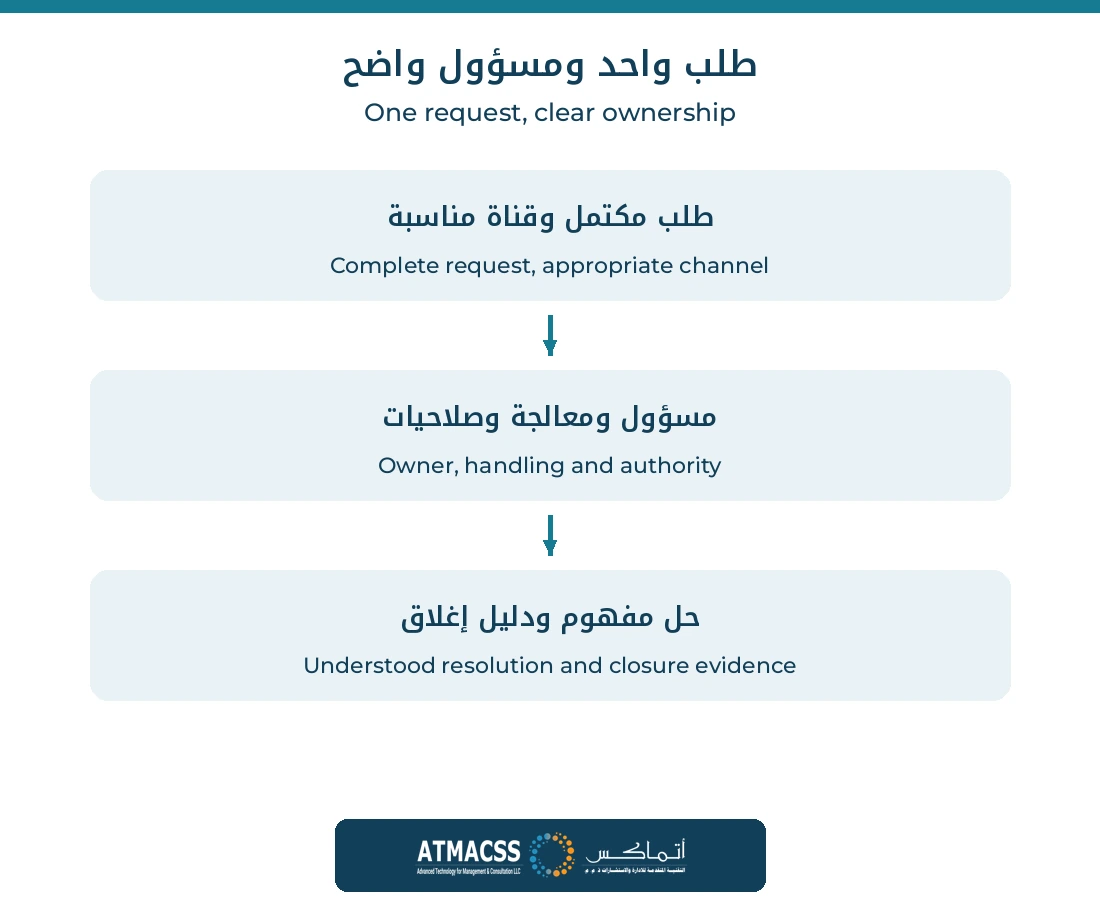
A shared inbox is a channel, not an owner. Assign someone to acknowledge the request, check whether the necessary information is present and arrange the next step. When the case moves between functions, keep the employee informed and make the handover responsibility explicit.
Agree service expectations with the people who must deliver them. Distinguish acknowledgement, investigation and resolution. A rapid automated acknowledgement does not mean the issue has been solved. Where another party’s approval is needed, record the dependency rather than resetting the clock to make the service appear faster.
Record the original receipt time and, separately, the time when required information is complete. Measure the employee’s total wait from receipt to delivery of the outcome. A service-level agreement (SLA) sets out a service and the commitments for delivering it. If it measures a narrower processing period, define working hours, permitted pauses and approval dependencies explicitly. Show that measure alongside total waiting time, and tell the employee when to expect the next update.
Worked example: repeated letter requests
Hypothetical example for illustration: An HR team receives 40 employment-letter requests in a month. In 12 cases it asks for missing information after submission. The team reviews which fields were missing and whether those fields are truly necessary. The incomplete-request rate is (12 ÷ 40) × 100 = 30%. Count each request once, even if it required several follow-up messages. The denominator includes all 40 requests received in that month, not only those completed. These numbers illustrate a process review, not an HR benchmark.
It replaces several informal request routes with a clearly explained form and keeps an assisted route for employees who cannot use it. The form asks only for relevant information. HR checks the approved data source rather than requiring employees to retype sensitive records unnecessarily.
During the next review, the team examines incomplete requests, time to resolution and letters needing correction. Compare the same request type over equal reporting periods using the same definitions. Record both counts and rates; a lower number of incomplete requests may simply reflect fewer requests overall. If completeness improves but employees find the form inaccessible, the change is not an unqualified success. The team adjusts the instructions or access method before expanding the process.
Protect time for work requiring judgement
Group routine requests where that improves consistency, but reserve capacity for complex cases, manager support and planned people work. Track the reasons for repeated demand. A recurring payroll question may indicate unclear payslip explanations or an upstream data issue, not insufficient effort by HR.
Build the team’s capability through relevant practice, supervision and current guidance. Give staff access to the expertise they need. Do not expect a junior administrator to resolve every specialist matter, and do not use automation to conceal missing decision authority.
Support the people delivering the HR service
A request process needs a capable, supported team behind it. Review demand and available capacity together: identify recurring work, sensitive cases, cover during absence and time reserved for professional development. Agree which demands can wait and which require escalation instead of expecting permanent availability.
- Development: choose a real capability gap, provide supervised practice and review the quality of the resulting work.
- Employee voice: give the team a regular opportunity to explain obstacles and challenge unrealistic service expectations. Record a decision and follow up.
- Wellbeing: examine workload, working hours and role clarity. Flexible arrangements should fit the work and be applied fairly; an appreciation event does not resolve an unmanageable workload.
- Recognition and inclusion: acknowledge accurate advice, fair handling and useful improvements, not only the number of cases closed. Make learning and feedback accessible to colleagues with different needs and working patterns.
CIPD’s workplace wellbeing guidance connects wellbeing with work design, employee voice and inclusion. Review these conditions alongside service measures rather than assuming faster responses demonstrate a healthier team.
Design confidentiality into the workflow
Limit access according to the purpose of the case and the person’s responsibility. Decide where records belong, how they are shared and when they should be retained or removed under the applicable rules. A dashboard can use aggregated categories without displaying personal case details.
Explain escalation routes for sensitive concerns and conflicts of interest. An employee should not be forced to disclose a concern to the person who is the subject of it simply because that person is the ordinary manager. Confirm the appropriate authorised route in the relevant policy, and explain confidentiality and referral limits without promising absolute secrecy.
Measure resolution quality and start small
Review backlog age: the time since each open request was received. Consider repeat contacts, corrections and employee understanding alongside response times. A case closed in the system may still be unresolved from the employee’s perspective. Use a small sample to check whether the answer was correct, understandable and delivered through an appropriate channel.
Define closure for each service. A letter request may be closed after the authorised document is checked and delivered, with delivery evidence recorded. If a request cannot be approved, communicate the reason and any available review route under the relevant policy. Record reopened cases against the original request so that repeated closure does not inflate completed-request counts. A closed status alone is not proof of employee satisfaction.
Start with one frequent routine request. Map its steps, owner, dependencies and completion evidence with HR and the users. Connect this work to HR systems and the broader HR strategy. ATMACSS business and operations modelling support can help define the workflow and responsibilities.
Conclusion: a clear service and a team able to deliver it
Supporting HR starts with defining services and responsibilities, then providing an appropriate route for each request. Clear authority, considered confidentiality and a team with sufficient time and expertise make that service workable. Test one recurring request first. Review information completeness, total waiting time and the accuracy of the outcome. Expand when the review shows that the process is understandable and practical, while protecting sensitive cases and work quality.