



More online orders do not always mean a more profitable business. A discount, an expensive acquisition channel or frequent returns can absorb the value of a sale. This article explains how to calculate contribution per order, connect it to fixed costs and examine cash timing using a simple illustrative example rather than promised financial results.
Separate revenue, contribution and profit
Revenue is the value of sales recognised under the applicable accounting approach. Contribution is the amount remaining after the variable costs included in the analysis. It helps cover fixed costs and then contributes to profit. Profit requires the relevant expenses to be considered; it is not the same as cash in the bank.
Define your unit before calculating. It might be one completed order, one subscription period or one service engagement. Use a consistent period and treatment of discounts, returns and taxes. If your accounting records use a different basis, reconcile the management calculation with them.
A worked order example
The following fictional example uses AED and excludes VAT. It is a simplified management calculation, not a tax calculation or a benchmark for online shops.
| Item per order | AED |
|---|---|
| Net selling amount after discount | 200 |
| Product cost | 90 |
| Delivery, packaging and payment costs | 30 |
| Expected returns cost allowance | 10 |
| Allocated acquisition cost | 25 |
| Contribution after these costs | 45 |
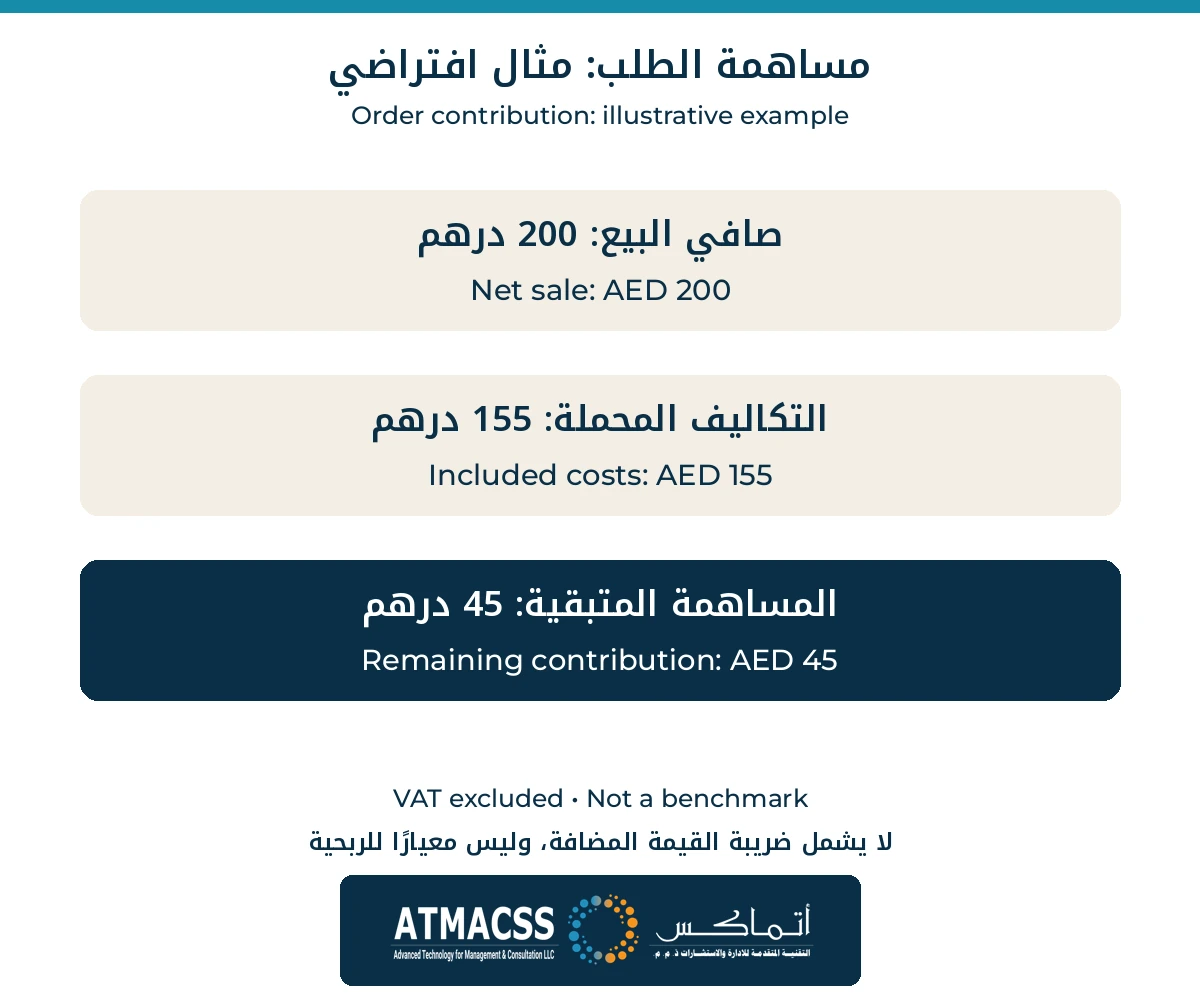
The calculation is 200 − 90 − 30 − 10 − 25 = 45. Without the acquisition allocation, contribution is 70. Label the two measures clearly so that teams do not compare different definitions under the same name.
If fixed costs for the period are AED 9,000 and every order has the same AED 45 contribution, the simplified break-even volume is 200 orders. This assumes the cost pattern holds. A changing product mix or additional capacity costs will alter the calculation.
Allocate acquisition costs carefully
Customer acquisition cost concerns the cost of obtaining customers, not automatically the cost of each order. A customer may place several orders. In the example, AED 25 is an explicit allocation to the analysed order, not a claim that all acquisition costs behave as a variable expense.
Apply the same discipline to returns: explain what the AED 10 allowance covers. If refunds have already reduced revenue, do not deduct the same amount again as a returns cost. The allowance may include additional costs not yet counted, such as return shipping or product damage, after considering recoverable value. Use the same order records and an observation period long enough for returns to emerge. Comparing recent orders with orders whose return cycle is complete can give a misleading impression.
Compare channels using consistent attribution and time periods. Avoid counting the same sale twice because two platforms both claim it. Track returns and repeat purchases before concluding that the cheapest initial customer is the most valuable.
Test a specific improvement
- Discount: recalculate contribution after the lower price and any realistic change in volume.
- Delivery offer: identify who bears the added cost and whether the change produces useful completed orders.
- Product description: check whether clearer information reduces avoidable returns.
- Retention: assess repeat purchases with their service and fulfilment costs, rather than treating them as free revenue.
Change one important assumption at a time in the worksheet. Use a downside case to show what happens when returns rise or acquisition becomes more expensive. Do not assume sales growth will correct negative contribution.
Prevent double counting and test a discount
In the preceding break-even example, the AED 9,000 fixed-cost total must exclude acquisition spending already counted in the AED 25 order allocation. If that spending remains within fixed costs, use contribution before acquisition allocation with the appropriate total cost base; do not mix the methods. Do not assume AED 25 stays constant as order volume changes when the underlying spend is a fixed budget.
Illustrative sensitivity: Reducing the order price from AED 200 to AED 180 while holding the stated costs constant cuts contribution from AED 45 to AED 25. Covering AED 9,000 under the same assumptions then requires 360 orders rather than 200. More orders alone do not make a discount successful. Recalculate when product mix, returns or acquisition costs change.
Suppose the shop sells 250 orders at the original price: revenue is AED 50,000, total contribution is AED 11,250, and the result after the stated fixed costs is positive AED 2,250. If the discount increases sales to 300 orders at AED 180, revenue becomes AED 54,000, but total contribution falls to AED 7,500, producing a loss of AED 1,500. Orders increased by 20% and revenue by 8%, yet the result deteriorated. Preserving the contribution from 250 orders before the discount would require 450 orders after it under the same assumptions. This is a fictional comparison before any other expenses outside the model, not a sales forecast.
Check cash timing separately
Keep the calculation with the data date, cost-allocation rules and the source of each amount. When updating the returns allowance, compare the previous estimate with actual results and explain the difference before changing the next period’s assumption. If order volume or mix changes, reassess allocated costs rather than copying an old average. This record explains why contribution changed and helps the finance owner distinguish an operational improvement from a change in calculation method.
A profitable order may still require cash before the customer pays or the payment provider settles. Map inventory payments, marketing payments, settlement timing and refunds. Keep a separate cash forecast alongside the profitability analysis.
Review the calculation with the person responsible for finance before using it for a major commitment. For wider assessment, see economic feasibility analysis and ATMACSS business development support.
Connect the calculation to the wider business
Order contribution is one part of profitability. Use it to evaluate commercial choices without overlooking customer demand, delivery and cash. The following review sequence combines those decisions; it does not promise a particular return.
- Audience and value: identify a specific customer problem and explain why the offer is worth paying for. Check assumptions with customer research before buying traffic.
- Website and fulfilment: make product information, delivery terms, payment and support easy to understand. Test the purchase journey on a phone and trace an order through delivery and refund handling.
- Acquisition and retention: compare channels using completed orders and their contribution after relevant costs. Evaluate repeat purchases after servicing and loyalty costs, rather than treating returning customers as free revenue.
- Revenue options: test a new product, subscription or partnership separately. Include additional support, fulfilment, refund and working-capital requirements before expanding.
- Permissions and learning: verify applicable trading, consumer, privacy and tax requirements with the relevant authorities or advisers. Keep a record of experiments, results and decisions so that unsuccessful tests change the next action.
Begin with market research and the online business operating guide, then use the order calculation above to test the economics. The SBA’s business planning resources offer further guidance on researching demand and competition; their US administrative requirements are not UAE rules.